


The Future of Cold Therapy Equipment for Sports and Healthcare
Cold therapy is moving far beyond traditional ice packs. Sports teams, physiotherapy clinics, rehabilitation centers, gyms, and healthcare distributors now want equipment that is easier to control, easier to use, and suitable for repeated professional use.
For distributors, wholesalers, and resellers, this change also creates a new purchasing question: how can you build a cold therapy product line that can grow with the market?
The answer starts with the right cold therapy equipment manufacturer. A good manufacturing partner should offer different cooling technologies, clear product specifications, stable production, OEM and ODM support, private label services, and reliable support for medium and large-volume orders.
ERCON has more than 17 years of experience in sports recovery equipment R&D and manufacturing. Its products are supplied to more than 100 countries, with more than 300 brand customization projects. The company operates a 12,000㎡ factory with 5 production lines, professional R&D and quality inspection teams, and a high-end product showroom.
- Why Cold Therapy Is Changing
- The Main Technologies Behind Modern Cold Therapy
- How to Build a Practical Product Portfolio
- CL01A: A Simple Entry Point for Multiple Markets
- CL03A: Adding Compression to Cold Therapy
- Why Hot and Cold Contrast Therapy Matters
- Where Different Products Fit
- How B2B Buyers Should Plan Bulk Purchasing
- Private Label Is the Next Step for Growing Brands
- What to Check Before Choosing a Manufacturer
- Why ERCON Can Support Long-Term Supply
- Q&A
Why Cold Therapy Is Changing
Traditional ice therapy is simple and cheap, but it is not always convenient for professional use. Ice needs to be prepared, replaced, and managed during treatment. Cooling can also change as the ice melts.
Modern cold therapy equipment uses water circulation, compression, cooling technology, or a combination of these functions. This gives professional users more control over the recovery process and makes the equipment easier to use again and again.
For B2B buyers, this creates more product choices. A distributor may need a basic cold water system for one customer, a cold compression system for another customer, and a hot and cold contrast device for a professional rehabilitation center.
This is why buying one product is no longer enough for many growing businesses. A complete product range can make it easier for a cold therapy equipment supplier to serve different customer groups with one manufacturing partner.
The Main Technologies Behind Modern Cold Therapy
The future of cold therapy is not based on one single technology. Different systems solve different purchasing needs.
Cold Water Circulation
Cold water circulation systems use chilled water that moves through a therapy pad. The design provides continuous contact between the cooling water and the treatment area.
This type of system is suitable for buyers who want a straightforward product for sports recovery, clinics, rehabilitation, and home recovery markets.
Cold Compression
Cold compression combines cooling with pneumatic pressure. Instead of offering only cold therapy, the machine adds adjustable compression to the treatment process.
This can make the product more attractive to professional recovery centers, sports teams, physiotherapy clinics, and distributors looking for multifunction equipment.
Hot and Cold Contrast Therapy
Some professional users need more than cooling. Hot and cold contrast systems allow the product range to cover both temperature-based recovery methods in one device.
For wholesalers, this creates a higher-function product category that can sit above basic cold water systems in the catalog.
Semiconductor Cooling and Heating
Semiconductor technology is another direction in modern therapy equipment. It can provide controlled cooling and heating without relying on the same water-and-ice process used by traditional systems.
ERCON's product range includes semiconductor cooling and heating devices alongside cold water systems and cold compression equipment. This gives B2B buyers more choices when building a complete recovery equipment portfolio.
How to Build a Practical Product Portfolio
A large product catalog does not automatically mean a better business. The important thing is to give each model a clear job.
A practical product portfolio can be divided into three levels.
- Basic cold therapy: suitable for general sports recovery, home recovery, fitness centers, and entry-level professional customers.
- Cold compression: suitable for sports teams, physiotherapy clinics, rehabilitation centers, and professional recovery facilities.
- Advanced contrast or semiconductor systems: suitable for customers looking for higher-function recovery equipment and a more complete therapy setup.
This approach gives a cold therapy equipment wholesale business a clear way to organize its catalog. Customers can choose based on function instead of simply comparing the appearance of several similar machines.
CL01A: A Simple Entry Point for Multiple Markets
The CL01A Compact Cold Water Cycling Therapy System is a useful example of how a relatively simple cold therapy system can serve several customer groups.
It has a 10L water capacity, 5 operating levels, ABS housing, and a flexible TPU therapy pad with a nylon elastic band. The unit weighs about 4–5kg depending on the listed configuration and supports AC100–240V, 50/60Hz power.
The flexible pad can be used on different body areas, including the knee, shoulder, back, hip, ankle, neck, and leg. This makes the system easier for distributors to position across different recovery applications.
For a reseller, the CL01A can be positioned as a portable cold water therapy solution. For a physiotherapy distributor, it can be included in a wider clinic recovery equipment range. For a sports equipment wholesaler, it can become part of a team recovery package.
The listed MOQ is 10–50 sets, with a listed lead time of 7–15 days and a 1–2 year warranty. Actual order terms should be confirmed for the selected model and project.
CL03A: Adding Compression to Cold Therapy
When customers need more functions from one device, cold compression becomes a stronger option.
The ERCON CL03A Portable Cold Water Compression Therapy System combines cold water circulation with pneumatic compression. It has a pressure range of 0–150 mmHg, an 8L capacity, and a flow rate of 370 ± 50 L/H.
The system also supports a 5–120 minute time setting and weighs about 3.2kg. Its cold pads use skin-friendly fabric and TPU, while adjustable straps help the pad fit different body areas.
These specifications make CL03A a useful option for customers that want more than basic cooling. It can fit sports recovery rooms, physiotherapy clinics, rehabilitation centers, and other professional recovery settings.
For a cold compression therapy machine distributor, this type of product can also create a clear step-up option in the catalog. Customers who need only cooling can choose a basic model, while customers who want cooling plus compression can move to CL03A.
Why Hot and Cold Contrast Therapy Matters
Another change in the market is the move toward multifunction recovery equipment.
Instead of buying one machine for cold therapy and another machine for heat therapy, some professional customers prefer a system that can support both functions. This can reduce equipment duplication and give the recovery room more treatment options.
ERCON's product range includes the CL08 Cold and Heat Contrast Compression Therapy Device, as well as CL02A, CL801Pro, CL802, and CL806 semiconductor cooling and heating systems.
This is important for distributors because different customers can be served from the same product family. A gym may need a basic cold therapy machine. A sports team may need cold compression. A rehabilitation center may want hot and cold contrast therapy.
One manufacturer can therefore support several sales channels instead of forcing the distributor to manage different factories for every product category.
Where Different Products Fit
Professional Sports Teams
Sports teams often need recovery equipment that can be used repeatedly during training and competition periods. Portable cold water systems and cold compression devices can be easier to move between training areas, recovery rooms, and events.
For distributors, the better approach is to offer a complete team recovery package instead of selling only one machine. Cold therapy can be combined with compression boots, massage equipment, and other sports recovery products.
Physiotherapy Clinics
Clinics usually need equipment that can support different treatment areas. A flexible cold therapy pad can be useful because one system may support the knee, shoulder, back, hip, or ankle.
For professional clinics, buyers should also review product documentation, warranty, electrical requirements, certification, and intended use before purchasing in volume.
Rehabilitation Centers
Rehabilitation centers may need several recovery technologies in one location. A cold water system can cover basic cooling needs, while cold compression and contrast therapy can provide additional product levels.
This makes a multi-product manufacturer more useful than a supplier that only produces one type of cold therapy machine.
Medical Equipment Distributors
Medical and healthcare distributors normally have stricter purchasing requirements. They may need model-specific certificates, technical documents, packaging information, warranty terms, and stable after-sales support.
Certification should always be checked against the exact model, destination market, and intended application. Do not assume that one certificate automatically covers every product in a manufacturer's catalog.
How B2B Buyers Should Plan Bulk Purchasing
Large orders should be planned around the sales channel, not just the factory quotation.
First, select the target market. Decide whether the main buyers are sports teams, clinics, rehabilitation centers, gyms, healthcare distributors, or online resellers.
Second, choose a small core range. Start with products that have clear differences in function. For example, a basic cold water system can cover general customers, while a cold compression system can target professional buyers.
Third, test samples. Check cooling performance, pad fit, controls, water capacity, compression settings, packaging, accessories, and user experience before mass production.
Fourth, lock the specification. Confirm the exact model, color, logo, packaging, accessories, electrical standard, user manual, and required compliance documents.
Fifth, prepare for repeat orders. Once a model performs well, the supplier should be able to reproduce the same specification for future batches.
ERCON supports sample development for applicable projects and promotes 2-day sampling for selected requirements. Its product pages also list MOQ and lead-time information for individual models, such as 10–50 sets and 7–15 days for CL01A and CL03A. Actual timing should be confirmed according to the order and customization details.
Private Label Is the Next Step for Growing Brands
Many distributors start by buying standard products. After testing the market, they may want their own brand.
This is where private label cold therapy equipment becomes useful.
ERCON supports private label logo, product color, packaging, and accessories. OEM and ODM projects can also be discussed for suitable products.
A growing brand can start with a standard model, approve a sample, and then develop a branded version after customer feedback. This reduces the need to design a complete product from zero.
Private label can also be used to create several product levels under one brand. For example, the same brand could offer a compact cold water system, a cold compression machine, and a higher-end hot and cold contrast system.
This creates a cleaner product family for distributors and makes future product expansion easier.
What to Check Before Choosing a Manufacturer
When purchasing cold therapy equipment in medium or large quantities, the factory itself should be part of the evaluation.
- R&D capability: Can the factory develop and improve products?
- Production capacity: Can it handle repeat and larger orders?
- Quality control: Are incoming materials, production, and finished products inspected?
- Customization: Can it provide logo, color, packaging, and accessory customization?
- Product range: Can it provide several cold therapy technologies?
- Sampling: Can buyers test products before mass production?
- Factory inspection: Can the buyer inspect the manufacturing site?
- Documentation: Can the supplier provide model-specific technical and compliance documents?
- After-sales support: Is there a clear process for warranty and replacement parts?
These points are especially important for wholesalers and distributors because their reputation depends on product consistency across repeated orders.
Why ERCON Can Support Long-Term Supply
ERCON combines product development, manufacturing, customization, and international B2B supply in one system.
The company has more than 17 years of sports recovery equipment R&D and manufacturing experience. Its products are supplied to more than 100 countries, and it has completed more than 300 brand customization projects.
Its 12,000㎡ manufacturing facility includes 5 production lines, professional R&D and quality inspection teams, and a high-end showroom. ERCON also supports factory inspection, allowing qualified B2B buyers to review the manufacturing environment before moving to larger orders.
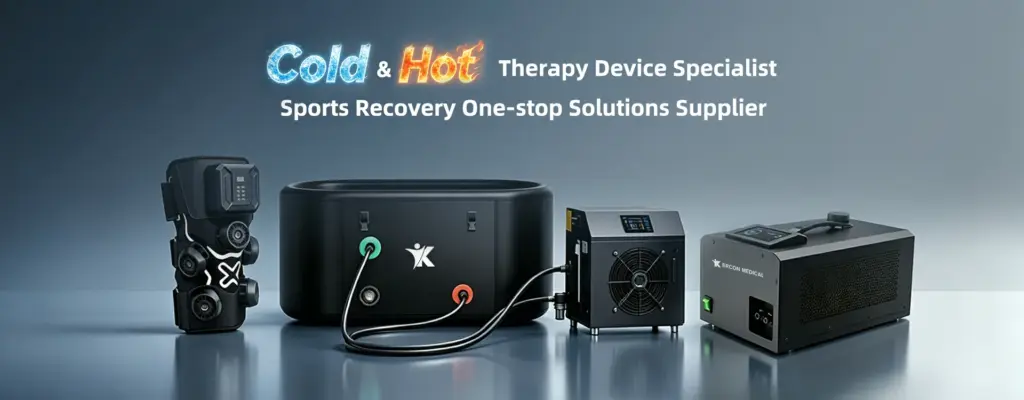
ERCON's product range covers cold water therapy, cold compression therapy, hot and cold contrast therapy, semiconductor cooling and heating equipment, and ice bath solutions. It also offers other sports recovery equipment, allowing distributors to expand their product range without creating multiple supplier relationships.
For international projects, ERCON supports applicable CE, ISO, RoHS, and BSCI-related requirements. Exact certificates and compliance documents should be confirmed according to the model and destination market.
For buyers that need a cold therapy equipment manufacturer for medium or large-volume purchasing, the next step is to compare models by technology, application, specifications, customization, and production requirements rather than choosing only by unit price.
View the complete cold therapy equipment range from ERCON and select the models that best match your distribution or wholesale market.
Q&A
What is the future of cold therapy equipment?
The market is moving toward controlled cooling, cold compression, hot and cold contrast therapy, semiconductor cooling and heating, and more flexible recovery systems. Buyers also want manufacturers that can provide several technologies under one supply chain.
What should a distributor look for in cold therapy equipment?
Key points include cooling technology, water capacity, flow rate, pressure range, treatment time, pad design, controls, power requirements, accessories, warranty, certification, and long-term production support.
What is the difference between cold water therapy and cold compression?
Cold water therapy circulates chilled water through a therapy pad. Cold compression adds pneumatic pressure to the cooling process. The right choice depends on the customer's application and required functions.
What are the main specifications of the ERCON CL03A?
The CL03A has an 8L capacity, 0–150 mmHg pressure range, 370 ± 50 L/H flow rate, 5–120 minute time setting, and a machine weight of about 3.2kg. It combines cold water circulation with pneumatic compression.
Is CL01A suitable for different body areas?
Yes. Its flexible therapy pad and straps are designed for use on areas such as the knee, shoulder, back, hip, ankle, neck, and leg. This makes it suitable for several recovery applications.
Can ERCON provide private label cold therapy equipment?
Yes. ERCON supports private label logo, color, packaging, and accessory customization. OEM and ODM development can also be discussed according to the product and project requirements.
Can ERCON support wholesale and large-volume orders?
Yes. ERCON works with distributors, wholesalers, resellers, and private-label brands. Its factory has 5 production lines and supports sampling, customization, bulk production, and factory inspection for applicable B2B projects.
Can buyers inspect the ERCON factory before a large order?
Yes. ERCON supports factory inspection. Buyers can use the inspection process to review production capability, quality control, R&D resources, and the manufacturing environment before confirming a larger purchasing program.