


How to Find a Long-Term Cold & Hot Therapy Equipment Partner
For a distributor, wholesaler, or reseller, choosing a recovery equipment supplier is not only about finding a good product. The bigger question is whether the supplier can support your business after the first order.
A long-term partner should offer stable product quality, clear specifications, reliable production, fast sampling, customization, quality control, and support for repeat orders. These points become even more important when you plan to move from a test order to medium or large-volume purchasing.
For businesses entering the recovery equipment market, a cold and hot therapy equipment partner should also understand different applications. Sports teams, rehabilitation centers, physiotherapy businesses, gyms, recovery studios, and home recovery markets may have different product needs.
- Why a Long-Term Partner Matters
- Start With Your Product and Market
- What the EK-810 Offers B2B Buyers
- Check Temperature Performance
- Check Pneumatic Compression
- Check the Wrap and Water System
- Where Can the Equipment Be Used?
- What Makes a Good Equipment Supplier?
- OEM, ODM, and Private Label Support
- Why Factory Capacity Matters
- Quality Control and Certifications
- Can the Supplier Support Repeat Orders?
- Why ERCON Is Built for B2B Partnerships
- A Simple Sourcing Process
- Q&A
Why a Long-Term Partner Matters
A first order can be easy. The real test comes with the second, third, and larger orders.
A distributor may first buy a small quantity to test the market. If customers respond well, the distributor may then need more units, new colors, customized packaging, additional accessories, or a wider product range.
This is where an experienced manufacturer can make a difference.
A long-term partner should be able to keep approved product specifications consistent while supporting larger production. The supplier should also have a clear process for samples, customization, inspection, packaging, and delivery.
For B2B buyers, this is more useful than simply choosing the lowest quotation. A low purchase price does not solve problems caused by inconsistent products, unclear specifications, delayed production, or weak after-sales support.
Start With Your Product and Market
Before contacting a manufacturer, define your target market.
For example, a distributor selling to professional sports teams may need a machine with multiple therapy functions and flexible treatment settings. A rehabilitation equipment supplier may focus on temperature control, compression options, wrap coverage, and ease of operation. A reseller may need private label packaging and accessories.
Knowing the target customer helps you choose the right equipment.
For a combined cold and hot therapy machine, buyers should review:
- Cold temperature range
- Heat temperature range
- Compression pressure range
- Water tank capacity
- Water flow
- Cooling capacity
- Time settings
- Wrap design
- Air chamber control
- Power supply
- Product weight
- Accessories
- Available customization
These details give buyers a better way to compare suppliers before discussing a larger order.
What the EK-810 Offers B2B Buyers
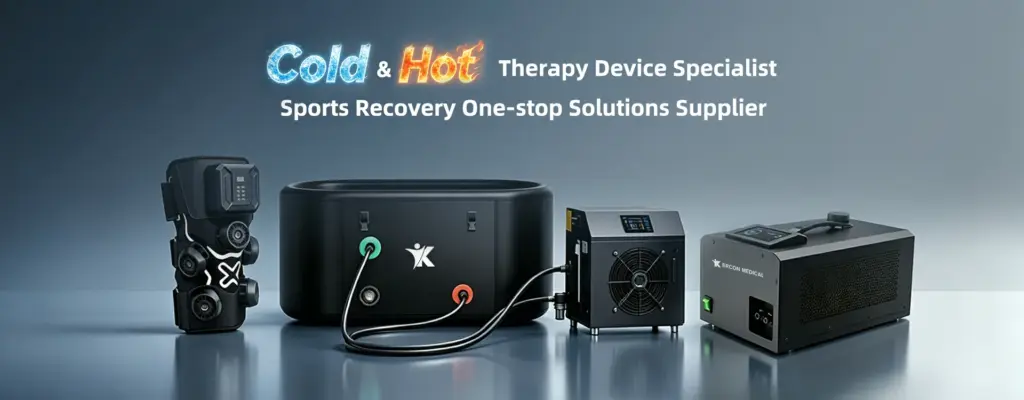
The ERCON EK-810 is designed as an all-in-one recovery system combining cold therapy, heat therapy, and pneumatic compression. This multi-function design gives B2B buyers a product that can serve several recovery applications without requiring separate machines for every function.
The EK-810 has a listed temperature range of 3–15°C for cooling and 40–55°C for heating. It also features a 2L water tank, 370±50L/h water flow, 550W refrigeration capacity, and a 30–180 mmHg pressure range. The listed time setting is 5–90 minutes.
The machine supports AC100–240V, 50/60Hz power input, which can be useful for international B2B projects. Buyers should confirm the final electrical configuration for the destination market before placing an order.
From a product positioning point of view, the main advantage is the combination of three functions in one system: cold, heat, and pneumatic compression.
Check Temperature Performance
Temperature control is one of the most important points when comparing a cold and hot therapy machine.
Do not only ask for the highest and lowest temperature. Ask how the machine reaches the selected temperature, how the water circulates, and how the system maintains the selected setting during use.
The EK-810 uses a 2L water tank and provides a water flow of 370±50L/h. Its circulation system is designed to maintain the selected temperature during operation. The cooling wrap provides coverage around the treatment area and avoids the need to prepare ice for every session.
This design can be useful for professional environments where staff need a simple and repeatable recovery setup.
For a B2B sample test, buyers should check:
- How quickly the temperature changes
- Whether the temperature remains stable
- Whether the water circulation is smooth
- Whether the wrap covers the target body area well
- Whether the connections remain secure during operation
Check Pneumatic Compression
The compression function is another major part of the product.
A pneumatic system uses air chambers to create controlled compression. For professional buyers, adjustable pressure is important because different applications may require different settings.
The EK-810 provides a listed pressure range of 30–180 mmHg. Its compression system supports adjustable levels and cycle settings. The system can also provide targeted compression for different areas, depending on the selected wrap and configuration.
The listed motor noise is below 45 dB, which may be useful in recovery rooms where a quieter environment is preferred.
For distributors and wholesalers, these specifications make it easier to position the machine for different professional users. Buyers should always confirm the exact model configuration before placing a bulk order.
Check the Wrap and Water System
Many buyers focus heavily on the main machine and forget about the wraps.
In real use, the wrap is one of the parts that customers handle directly. It should be easy to install, comfortable for the intended application, and properly connected to the main unit.
The EK-810 uses lightweight wraps designed for body-area coverage. The system can support cold therapy and compression together, while different wraps can be selected for different treatment areas.
The water system is also important. Buyers should inspect the water tubes, connectors, seals, and circulation system during sample testing.
During sample testing, buyers should inspect the wrap material, seams, connectors, seals, tubes, and overall fit rather than judging only the appearance of the machine.
Where Can the Equipment Be Used?
Sports Teams
Sports teams can place multi-function recovery equipment in training centers, locker rooms, or dedicated recovery rooms.
The EK-810 is suitable for recovery environments used by athletes and active users. It can be considered for applications following running, lifting, cycling, ball sports, and high-intensity training.
Rehabilitation Centers
Rehabilitation businesses may prefer equipment that combines several recovery functions in one system. A combined system can simplify equipment selection when cold therapy, heat therapy, and compression are all part of the product plan.
Buyers should always confirm local requirements before using or marketing the equipment for specific medical or rehabilitation purposes.
Recovery Studios
Recovery studios can use the equipment as part of a wider recovery service. The combination of temperature control and compression gives the business more options when planning recovery sessions.
Gyms and Fitness Centers
Gyms can place the machine in a dedicated recovery or wellness area. A combined system may be easier to manage than buying separate equipment for cold, heat, and compression.
Home Recovery
The equipment can also be positioned for selected home recovery markets. Buyers should review product size, power requirements, operating instructions, and local market regulations before choosing this sales channel.
What Makes a Good Equipment Supplier?
A professional supplier should be able to answer practical questions clearly.
Before choosing a long-term partner, ask about:
- Product specifications
- Sample availability
- MOQ
- Production capacity
- Lead time
- Quality inspection
- Certifications
- OEM and ODM services
- Private label options
- Packaging customization
- Accessory customization
- Spare parts
- Warranty
- Factory inspection
- Repeat-order support
For medium and large B2B orders, clear commercial terms can prevent problems later. Buyers should confirm MOQ, lead time, warranty, shipping arrangements, and customization requirements before production begins.
OEM, ODM, and Private Label Support
Many distributors and resellers want to build their own recovery brand instead of selling a completely standard product.
For this type of project, the manufacturer should be able to support more than a logo.
KONBEST and ERCON support suitable OEM and ODM projects with options including:
- Private label logo
- Product color customization
- Package customization
- Accessory customization
A good process starts with a clear product specification. The buyer should provide the logo, colors, package requirements, and accessory details. A customized sample can then be checked before bulk production.
This is especially useful for wholesalers and distributors that want a consistent product identity across several sales channels.
Why Factory Capacity Matters
A manufacturer should be able to support your business after the first order.
KONBEST has 17 years of sports recovery product development and manufacturing experience. The company has experience serving customers in more than 100 countries and supporting customization projects for more than 300 brands.
The manufacturing background includes a 12,000-square-meter factory, 5 production lines, a high-end product showroom, professional R&D resources, and quality inspection teams.
For a B2B buyer, these resources matter because larger orders require more than a good sample. The factory must have the people, equipment, processes, and production space to maintain approved specifications.
For larger projects, buyers can also request a factory inspection before moving forward.
Quality Control and Certifications
Quality control should be part of the purchasing process from the beginning.
For cold and hot therapy equipment, buyers should pay special attention to:
- Temperature control
- Water circulation
- Water sealing
- Compression performance
- Air chambers
- Wrap construction
- Power system
- Connectors and tubes
- Controller operation
- Final assembly
The company background includes CE, ISO, RoHS, and BSCI certifications. Buyers should confirm which certification applies to the exact model and destination market before using certification information in commercial materials.
A strong quality process should also include sample approval before mass production and inspection of the final batch before shipment.
Can the Supplier Support Repeat Orders?
This question is often missed during the first purchase.
A distributor may start with 10 or 20 sets. If the market responds well, the next order may be much larger. The supplier should be prepared for that change.
Before approving the first order, discuss how future orders will be handled.
A practical repeat-order plan should cover:
- Approved product specifications
- Approved sample
- Customization files
- Packaging specifications
- Accessory list
- Inspection requirements
- Production schedule
- Shipping schedule
- Spare parts
- After-sales support
This makes future purchasing easier and reduces the chance of misunderstandings.
Why ERCON Is Built for B2B Partnerships
ERCON focuses on sports recovery and rehabilitation equipment and brings 17 years of product development and manufacturing experience.
The company has experience serving customers in more than 100 countries and supporting customization projects for more than 300 brands. Its manufacturing base covers 12,000 square meters and includes 5 production lines, professional R&D resources, quality inspection teams, and a high-end product showroom.
For distributors, wholesalers, and resellers, ERCON can support suitable OEM and ODM projects, including logo, color, package, and accessory customization.
The company also supports 2-day sampling for suitable projects, 7-day shipping for suitable orders, and factory inspection support.
Another useful point is the broader product range. B2B customers can discuss different recovery categories with the same manufacturing team, helping them build a more complete recovery equipment portfolio instead of sourcing every product from a different factory.
A Simple Sourcing Process
Step 1: Define Your Customer
Decide whether your main customers are sports teams, gyms, clinics, rehabilitation centers, recovery studios, retailers, or other distributors.
Step 2: Choose the Right Functions
Decide whether you need cold therapy, heat therapy, pneumatic compression, or a combination of these functions.
Step 3: Compare Technical Specifications
Ask for the temperature range, pressure range, tank capacity, water flow, refrigeration capacity, time settings, power supply, product weight, wraps, and accessories.
Step 4: Request a Sample
Test the actual machine before making a larger commitment. Check temperature changes, water circulation, compression, noise, wraps, connectors, and controls.
Step 5: Confirm Customization
If you need a private label product, approve the logo, colors, packaging, accessories, and other details before mass production.
Step 6: Review the Factory
For larger orders, factory inspection can help confirm production conditions, quality control, and manufacturing capability.
Step 7: Plan Future Orders
Discuss repeat-order specifications, lead times, packaging, spare parts, and after-sales support before the first bulk shipment.
Why One Recovery Manufacturer Can Be Easier for B2B Buyers
A distributor often needs more than one recovery product.
For example, a sports equipment distributor may need cold therapy machines, compression boots, massage equipment, and other recovery products. Working with several unrelated factories can increase communication, sample testing, packaging, and quality-control work.
A manufacturer with a wider recovery product range can provide a more organized sourcing process.
This does not mean every product must come from one supplier. Instead, it gives buyers another option when they want to simplify product development and purchasing.
Final Thoughts
Finding a long-term cold and hot therapy equipment partner requires more than checking the product price.
A strong B2B relationship starts with the right product and continues with stable manufacturing, clear specifications, quality control, customization, reliable communication, and the ability to support repeat orders.
The EK-810 is a multi-function recovery product that combines cold therapy, heat therapy, and pneumatic compression. Its key listed specifications include a 3–15°C cold range, 40–55°C heat range, 30–180 mmHg pressure range, 2L water tank, 370±50L/h water flow, 550W refrigeration capacity, and AC100–240V, 50/60Hz input.
For distributors, wholesalers, and resellers, the best next step is simple: define your market, request a sample, test the equipment, confirm the specifications, review customization options, inspect the factory when needed, and then move toward the appropriate order volume.
With 17 years of recovery equipment experience, international market experience, 12,000 square meters of manufacturing space, 5 production lines, OEM/ODM support, customization services, sampling support, and factory inspection support, ERCON can be considered by B2B buyers looking for a manufacturing partner rather than a one-time supplier.
Q&A
Q1: What should I check before choosing a cold and hot therapy equipment supplier?
Check temperature performance, compression range, water circulation, wrap quality, controller design, certifications, production capacity, MOQ, lead time, customization, warranty, and factory inspection support.
Q2: What therapies does the EK-810 combine?
The EK-810 combines cold therapy, heat therapy, and pneumatic compression in one multi-function recovery system.
Q3: What is the temperature range of the EK-810?
The listed cooling range is 3–15°C, while the listed heating range is 40–55°C. Buyers should confirm the final specification for their exact order before production.
Q4: What is the compression pressure range?
The listed compression pressure range is 30–180 mmHg.
Q5: Who can use the EK-810?
The equipment can be positioned for sports teams, athletic trainers, physiotherapy-related businesses, rehabilitation centers, recovery studios, gyms, active users, and selected home recovery markets. Buyers should match the product with the rules and intended use of each target market.
Q6: Can ERCON provide private label customization?
Yes. Suitable B2B projects can include private label logo, product color, packaging, and accessory customization.
Q7: Can I test a sample before a bulk order?
Yes. ERCON supports 2-day sampling for suitable projects, allowing buyers to evaluate the product before moving into larger production.
Q8: Does ERCON support factory inspection?
Yes. Factory inspection support is available for B2B buyers who want to review the manufacturing environment before placing a larger order.
Q9: Can ERCON support medium and large B2B orders?
Yes. The company has a 12,000-square-meter manufacturing base and 5 production lines, supporting medium and larger purchasing projects according to order requirements.
Q10: Can I source other recovery equipment from ERCON?
Yes. ERCON has a broader recovery equipment portfolio, which can help distributors and wholesalers build a wider product range and discuss one-stop sourcing requirements.