


OEM, ODM, or Private Label Compression Boots? A Sourcing Guide for B2B Buyers
When you plan to buy compression boots in bulk, choosing a product is only the first step. You also need to decide how the product will be designed, manufactured, and sold under your brand.
Should you work with a factory through OEM? Do you need ODM product development? Or is private label a better way to build your own recovery equipment range?
These three models serve different business needs. The right choice depends on your product plans, technical requirements, target customers, and order volume. For distributors, wholesalers, importers, and resellers, it is important to understand these differences before selecting a compression boots manufacturer.
ERCON is a cold and hot therapy equipment specialist with 17 years of sports recovery product R&D and manufacturing experience. Its air compression boots range covers 4-chamber, 6-chamber, and 8-chamber models. ERCON supports OEM, ODM, and private label projects for international B2B customers.
Table of Contents
- 1. Start with Your Business Plan, Not the Factory's Product List
- 2. OEM, ODM, and Private Label: Three Different Ways to Work
- 3. Which Manufacturing Model Should You Choose?
- 4. Product Selection: What Do the Compression Boot Specifications Mean?
- 5. ERCON Product Examples for Different Market Positions
- 6. How Different B2B Buyers Can Build Their Product Range
- 7. How to Move from Sample Testing to Bulk Production
- 8. How to Evaluate a Compression Boots Manufacturer
- 9. ERCON Manufacturing and Customization Support
- 10. Q&A: Common Questions from Wholesale Buyers
1. Start with Your Business Plan, Not the Factory's Product List
Before asking for a quotation, think about what you want to sell and who will buy it. A distributor supplying fitness stores has different needs from an importer supplying professional sports facilities.
For example, one buyer may want a ready-made compression boot with a private label logo. Another may need a special air chamber layout or a different control system. These buyers should not follow the same sourcing process.
Start with four questions:
- Who are your customers? Fitness stores, gyms, sports clubs, rehabilitation equipment dealers, online resellers, or professional teams?
- What product level do they need? A basic model, a feature-rich wireless model, or a more advanced multi-chamber configuration?
- How much customization do you need? Logo and packaging only, or changes to the product design and functions?
- What is your purchasing plan? A sample order, a first wholesale shipment, or a long-term supply agreement?
These answers help you decide whether OEM, ODM, or private label is the right way to work with a factory.
They also help the manufacturer provide a more useful quotation. Instead of receiving a general price list, you can compare products and services that match your actual requirements.
2. OEM, ODM, and Private Label: Three Different Ways to Work
The main difference between OEM, ODM, and private label is the level of product design and development responsibility.
OEM Compression Boots: You Bring the Product Requirements
OEM stands for Original Equipment Manufacturing. In a typical OEM project, the buyer provides the product design, technical drawings, or detailed specifications. The factory manufactures the product according to the approved requirements.
This model is suitable for established brands and importers that already have a product plan.
For compression boots, an OEM specification may include:
- Air chamber number and arrangement.
- Pressure range and adjustment settings.
- Compression modes and working sequence.
- Air pump performance.
- Battery capacity and power supply.
- Control screen, remote, or app functions.
- Boot materials, size, and construction.
- Packaging, accessories, and product labels.
Example: A sports recovery brand in the United States has designed its own wireless compression boot. It has confirmed the chamber layout, pressure range, and control functions. It needs a factory to review the design, make samples, and manufacture the product according to its specifications.
OEM is a logical choice because the buyer already knows what the product should be. The factory's main role is technical review, manufacturing, and quality control.
ODM Compression Boots: You Bring the Market Requirements
ODM stands for Original Design Manufacturing. In this model, the manufacturer provides an existing product design or helps develop a product based on the buyer's requirements.
ODM is useful when you understand your customers but do not have a complete product design or engineering team.
For example, a distributor may want compression boots with wireless operation, several pressure settings, and a specific appearance. The distributor can explain these needs to the factory. The factory then checks its existing models and reviews which changes are possible.
An ODM project may involve:
- Reviewing the target market and intended product use.
- Selecting an existing product platform.
- Evaluating new functions or structural changes.
- Preparing product samples.
- Testing the updated design.
- Confirming the final technical specifications.
ODM can reduce the amount of design work required from the buyer. However, a new product configuration may need extra development time, testing, and sample approval.
Before starting, agree on development costs, tooling requirements, design ownership, and the right to use the final design.
Private Label Compression Boots: You Bring the Brand
Private label compression boots are usually based on an existing factory model. The buyer selects the product and sells it under its own brand.
Common customization options include:
- Logo: Add your brand logo to approved product areas and packaging.
- Color: Select available product colors or discuss custom colors.
- Packaging: Use branded retail boxes, labels, and shipping cartons.
- Accessories: Discuss chargers, hoses, carry bags, and other package items.
- Documents: Prepare branded manuals and product information where available.
Example: A German sports equipment wholesaler already supplies gyms and fitness stores. It wants to add compression boots to its catalog under its own brand. It does not need a new air compression system. It needs a suitable model, consistent product quality, branded packaging, and a manufacturer that can support repeat orders.
Private label can meet this need with less product development work than a fully customized OEM or ODM project.
3. Which Manufacturing Model Should You Choose?
There is no single best model for every buyer. Use the following guide to match your current business situation with the right cooperation method.
| Your Business Situation | Recommended Model | What the Factory Needs to Provide |
|---|---|---|
| You already have product drawings and detailed technical requirements. | OEM | Technical review, sample production, and manufacturing based on approved specifications. |
| You know what your customers need but do not have a complete design. | ODM | Product selection, design support, development, and sample testing. |
| You want to sell an existing product under your own brand. | Private Label | Suitable models, logo, color, packaging, and accessory customization. |
| You want an existing product with several technical changes. | ODM or OEM | A technical review to define which changes are possible and who is responsible for the design. |
| You want to test a new product category before investing in development. | Private Label | Existing models, samples, and a clear first-order plan. |
One Important Point: Define the Project Scope
Some buyers use the words OEM and private label to describe the same project. This can cause problems when the order includes more than logo printing.
For example, adding a logo to an existing product is usually a private label service. Changing the air chamber structure or developing a new control system may require ODM or OEM work.
Before signing an agreement, write down exactly what will change, who will provide the design, who owns the tooling, and which party approves the final product.
4. Product Selection: What Do the Compression Boot Specifications Mean?
Choosing the right manufacturing model is only half of the sourcing decision. You also need to choose a product that matches your target customers.
When comparing compression boots, do not focus only on the number of air chambers. A useful product review should include the full technical configuration.
Air Chamber Number and Layout
Air chambers are the sections inside the boot that inflate and deflate during operation. Different chamber layouts create different compression zones and operating sequences.
ERCON offers 4-chamber, 6-chamber, and 8-chamber models. Buyers should compare the actual chamber arrangement and coverage instead of assuming that a higher chamber count is always better.
Pressure Range
Pressure range shows the adjustment range available on the device. A wider range gives the user more settings to choose from, but buyers should also check the control method and pressure adjustment steps.
For B2B sourcing, request the pressure specification for the exact model. Do not compare two products only by their maximum pressure value.
Air Pump Output
Air pump output affects how air is delivered to the chambers. Buyers can compare the stated air outlet, inflation performance, and noise level.
Ask the manufacturer how these values are measured and whether they apply to the complete product system or the pump component.
Battery and Power Supply
Wireless models can be useful in settings where users need more freedom to move or where a power cable is not convenient.
Check battery capacity, charging time, working time, charger specifications, and whether the device can also operate with an external power supply.
Control and Timer Functions
Some models use buttons or a remote, while others have an LCD screen or app control. The right choice depends on the target user and the way the product will be used.
For wholesale buyers, simple operation and clear product instructions can also reduce questions from retailers and end users.
5. ERCON Product Examples for Different Market Positions
ERCON's air compression boots range gives distributors several configurations to compare. The following examples show how product specifications can support different catalog plans.
9490 Standard: A 4-Chamber Model
The 9490 Standard is an entry-level configuration in the ERCON range. Its product page lists:
- 4 air chambers.
- 3 massage modes.
- Pressure range of 50–200 mmHg.
- 3200mAh rechargeable battery.
- 10, 20, and 30-minute timer settings.
- Remote and app control options.
This model may suit distributors who want a straightforward product option for general fitness and home-use recovery equipment channels.
For private label buyers, the next step is to confirm the selected control version, package contents, and available branding options.
9690K-C: A 6-Chamber Model with a Touch Screen
The 9690K-C is a professional 6-chamber model with an overlapping chamber design. Its listed specifications include:
- 6 air chambers.
- 6 massage modes.
- Pressure range of 30–260 mmHg.
- 15 L/min air outlet.
- 5200mAh rechargeable battery.
- 10–90-minute timer settings.
- Color LCD display.
- Listed noise level below 45 dB.
The overlapping chamber design is intended to provide full-leg compression coverage from the foot to the thigh. Its rechargeable battery supports wireless operation, while the LCD display provides direct access to the settings.
This configuration may be worth considering for sports recovery distributors, gyms, training facilities, and professional equipment suppliers that need a feature-rich product in their catalog.
9890K-C: An 8-Chamber Model
The 9890K-C is an 8-chamber model with an overlapping chamber design. Its product page lists:
- 8 air chambers.
- 6 massage modes.
- Pressure range of 30–260 mmHg.
- 5200mAh rechargeable battery.
- 10–90-minute timer settings.
- LCD touch screen.
- Listed noise level below 45 dB.
The product page contains different air pump output descriptions in separate sections. Buyers should request the latest signed technical specification before comparing this figure or confirming an order.
This model gives distributors another option when building a product range with different chamber configurations. Its suitability should be judged by sample testing, product fit, operating functions, and the needs of the target market.
How to Build a Balanced Product Range
For a distributor, offering one model to every customer may not be the best approach. A more useful plan is to select a small group of products with clear differences.
| Product Level | Example Model | Possible Customer Channel |
|---|---|---|
| Basic configuration | 9490 Standard | General fitness stores and home-use equipment resellers |
| Feature-rich configuration | 9690K-C | Sports recovery distributors, gyms, and training facilities |
| Advanced chamber configuration | 9890K-C | Specialist recovery equipment suppliers and advanced product catalogs |
This is a suggested product positioning plan, not a ranking of product quality. Always compare the complete specifications and test the products before deciding which models to purchase.
6. How Different B2B Buyers Can Build Their Product Range
The same compression boot may be sold through different business channels. Your sourcing model should match how your company operates.
For Fitness Equipment Distributors
Suggested plan: Compare the 4-chamber and 6-chamber models first. Use private label if you want a consistent brand across your existing fitness equipment range. Add more advanced configurations when customer demand supports them.
For Sports Recovery Wholesalers
Wholesalers may supply many resellers across different cities or countries. They need stable product configurations, clear packaging information, spare parts support, and repeat-order planning.
Suggested plan: Select a few core models and confirm the approved specifications for each one. Discuss private label packaging and accessories so that the product range has a consistent brand identity.
For Importers and Regional Resellers
Importers may understand their local market but need support with product selection, technical documents, labels, and packaging.
Suggested plan: Start by comparing existing models and testing samples. Private label may be suitable for the first product launch. If the market requires a special function or product structure, discuss an ODM project with the factory.
For Established Recovery Brands
Established brands may have their own product specifications, engineering resources, and quality standards. They may need more control over the product design and manufacturing process.
Suggested plan: Consider OEM when you already have a complete design. If you need the factory to help develop a new configuration, discuss ODM. Confirm design ownership, tooling, testing, and production responsibilities in writing.
7. How to Move from Sample Testing to Bulk Production
A good sourcing process helps prevent mistakes before a large shipment is produced. Do not move directly from a product photo to a purchase order.
Step 1: Send the Manufacturer a Clear Inquiry
Include the information that affects product selection and quotation:
- Destination country or sales market.
- Business type and target customers.
- Preferred model or technical requirements.
- Estimated order quantity.
- OEM, ODM, or private label requirements.
- Packaging and accessory needs.
- Expected delivery schedule.
A clear inquiry helps the manufacturer recommend suitable models instead of sending an unrelated product list.
Step 2: Compare Technical Specifications
Request the latest specification sheet for each selected model. Compare chamber count, pressure range, modes, pump output, battery, timer, controls, materials, and package contents.
Check that the quotation and technical sheet refer to the same model number and product version.
Step 3: Request and Test Samples
A sample allows your team to check the actual product before mass production. Test the inflation sequence, pressure adjustment, control functions, charging, air leakage, zippers, materials, and product fit.
For private label orders, check the logo position, color, packaging artwork, labels, and accessories. Approve these details before the factory starts the full order.
Step 4: Confirm MOQ and Production Schedule
MOQ and lead time depend on the model, order quantity, stock, and customization level. ERCON product pages list an MOQ range of 10–50 sets and a lead time of 7–15 days for selected models.
These figures are product-page references, not a universal promise for every order. Confirm the current MOQ, production schedule, sample time, inspection time, and shipping plan with the factory.
Step 5: Agree on Quality Inspection
Before production, define how the bulk order will be checked. Inspection items may include:
- Model number and approved configuration.
- Air pump and compression functions.
- Battery and charging operation.
- Boot materials, zippers, and connections.
- Logo, color, and packaging.
- Accessories and user documents.
- Carton labels and shipping marks.
Keep the approved sample and technical sheet as the reference for the bulk order. If a component or specification needs to change, request approval before production.
8. How to Evaluate a Compression Boots Manufacturer
A supplier may offer a low unit price, but a large order needs more than a competitive quotation. You should check whether the manufacturer can support product quality, customization, production planning, and after-sales service.
| Evaluation Area | What B2B Buyers Should Check |
|---|---|
| Manufacturing experience | Years of product development and manufacturing experience in sports recovery equipment. |
| Factory resources | Production area, production lines, equipment, and manufacturing team. |
| R&D capability | Ability to review OEM specifications and support ODM development. |
| Quality control | Incoming material checks, production inspection, and finished-product testing. |
| Customization | Logo, color, packaging, accessory, and product development options. |
| Bulk order support | MOQ, production schedule, repeat-order consistency, and shipment planning. |
| After-sales support | Warranty terms, spare parts, repair process, and issue handling. |
| Compliance documents | Current documents applicable to the exact model and destination market. |
| Factory inspection | Whether the buyer can arrange a factory visit or third-party inspection. |
Check Certificates Carefully
International buyers should not rely on a general statement that a factory has certificates. Ask for the actual documents and check their issuing organization, validity, scope, and product coverage.
CE and RoHS relate to different product compliance requirements. ISO9001 and ISO13485 are management-system standards with different scopes. BSCI relates to social compliance assessment. These documents are not interchangeable, and a company-level certificate does not automatically prove that every product model meets every market requirement.
For EU imports, confirm the regulations and technical documents that apply to the exact product and its intended use before placing a large order.
9. ERCON Manufacturing and Customization Support
ERCON focuses on cold and hot therapy and sports recovery equipment. Its product range includes air compression boots, self-developed water-vapor integrated cold and hot therapy rehabilitation devices, smart wearable cold and hot therapy equipment, and ice bath tubs.
This range gives distributors the option to discuss several recovery equipment categories with one manufacturing partner.
Manufacturing Experience and Production Resources
ERCON's company background includes:
- 17 years of sports recovery equipment R&D and manufacturing experience.
- Products supplied to more than 100 countries.
- More than 300 brand customization projects.
- Company-reported support from more than 20,000 professional athletes.
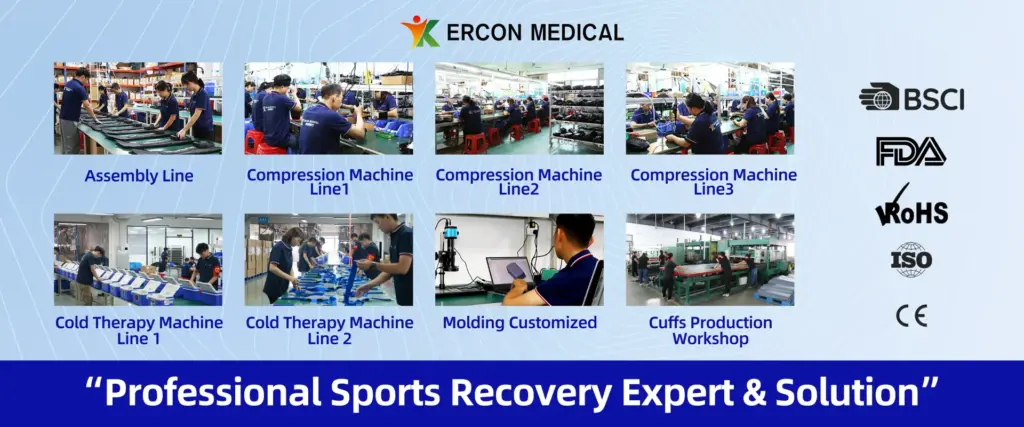
- A 12,000-square-meter manufacturing facility.
- 5 production lines.
- A high-end product showroom.
- Professional R&D and quality inspection teams.
These resources support product selection, technical communication, customization, production planning, and quality inspection for B2B projects.
OEM, ODM, and Private Label Services
ERCON can discuss different cooperation methods according to your project requirements.
- OEM: Manufacturing based on the buyer's approved design and technical specifications.
- ODM: Product selection, technical review, and development support according to the agreed project scope.
- Private Label: Logo, product color, packaging, and accessory customization for suitable models.
For applicable models and projects, ERCON supports 2-day sampling and 7-day shipping arrangements. Actual timing depends on stock, customization, order quantity, and destination. Confirm the schedule for your selected model before placing an order.
Factory Inspection and Quality Documentation
ERCON supports factory inspection for B2B buyers. Distributors and importers can discuss inspection arrangements and the production and quality information they need to review before confirming a larger order.
ERCON also provides applicable CE, ISO, RoHS, BSCI-related, and other documentation according to the product and market. Buyers should request the current documents for the exact model and check their scope and validity.
One-Stop Sports Recovery Equipment Sourcing
For businesses that want to expand beyond compression boots, ERCON can also discuss cold therapy systems, hot and cold contrast therapy devices, smart wearable recovery products, and ice bath tubs.
This can help distributors plan a broader recovery equipment catalog and discuss product selection, customization, and supply requirements across several categories.
Planning a medium- or large-volume compression boots order? Send ERCON your target market, estimated quantity, preferred product configuration, and customization requirements. The team can help compare suitable models and discuss the right OEM, ODM, or private label solution.
10. Q&A: Common Questions from Wholesale Buyers
ERCON's product development focuses on several sports recovery categories, including:
- Red light therapy devices.
- Self-developed water-vapor integrated cold and hot therapy rehabilitation equipment.
- Smart wearable cold and hot therapy devices.
- Ice bath tubs and water chillers.
- Cold compression therapy systems.
- Air compression recovery boots.
- Percussion massage devices.
- PEMF equipment.
This is an important advantage for distributors who want to build a broader sports recovery brand.
For example, you can start with wearable red light therapy devices and later add smart cold and hot therapy products or ice bath systems. This creates more product options for gyms, sports teams, recovery centers, and wellness facilities.
OEM and ODM Customization
ERCON supports private label projects with:
- Custom logo printing.
- Product color customization.
- Custom packaging.
- Accessory customization.
- Product configuration discussions.
- OEM and ODM development support.
For brand owners, this means you can begin with an existing product model and discuss further customization based on your business needs.
Quality and Compliance Support
ERCON has dedicated R&D and quality inspection teams and provides relevant product documentation for buyer review.
For larger orders, factory inspection support is also available to help buyers review production facilities and quality management procedures.
2-Day Sampling and 7-Day Shipping Support
To help international buyers move projects forward, ERCON offers:
- 2-day sampling support for applicable products and confirmed requirements.
- 7-day shipping support for applicable orders and logistics conditions.
- Factory inspection support.
- OEM/ODM customization services.
- Support for repeat orders and long-term B2B cooperation.
These services help buyers move from product selection to sample approval, customization, production, and shipment.
For distributors and wholesalers, ERCON's wider sports recovery equipment range also makes it possible to discuss several product categories with one manufacturing partner.
Start by reviewing the ERCON Red Light Therapy Product Collection.
You can also visit the ERCON OEM and ODM Manufacturing Service Page to learn more about private label and product customization.
Turn Your Brand Plan into an OEM Project
Launching your own red light therapy brand requires the right products, a clear business plan, and a manufacturer that can support your growth.
Start by identifying your target customers. Then select suitable models, test samples, approve your private label design, and prepare a clear purchasing plan.
For medium and large-volume buyers, production capacity, quality control, delivery planning, and repeat-order support are just as important as the product itself.
With 17 years of sports recovery manufacturing experience, a 12,000㎡ factory, 5 production lines, and over 300 brand customization projects, ERCON provides OEM and ODM support for international recovery equipment businesses.
Ready to build your own red light therapy brand?
Send ERCON your target market, selected models, estimated order quantity, logo requirements, and packaging ideas. The team can help you review suitable products, arrange samples, and prepare a manufacturing quotation.
10. Frequently Asked Questions
Q1: What is the main difference between OEM and ODM compression boots?
With OEM, the buyer usually provides the product design or detailed specifications, and the manufacturer produces the product according to the agreed requirements. With ODM, the manufacturer provides an existing design or helps develop a product based on the buyer's needs.
Q2: Are private label compression boots suitable for distributors and wholesalers?
Yes. Private label is suitable for businesses that want to sell existing compression boot models under their own brand. Common options include logo, color, packaging, labels, and selected accessories.
Q3: Which model is best for a new compression boots brand?
If you want to start with an existing product and focus on branding, private label may be a practical choice. If you need product development support, consider ODM. If you already have detailed technical drawings, OEM may be more suitable.
Q4: What is the difference between 4-chamber, 6-chamber, and 8-chamber compression boots?
The main difference is the number and arrangement of air chambers. Buyers should also compare pressure range, operating modes, pump output, battery capacity, controls, materials, and product fit. More chambers do not automatically mean a better product for every user.
Q5: Can ERCON put my brand logo on compression boots?
Yes. ERCON supports private label options such as logo, product color, packaging, and selected accessories for suitable models. Confirm the available options and MOQ for your selected product.
Q6: What is the MOQ for ERCON compression boots?
ERCON product pages list an MOQ range of 10–50 sets for selected models. The actual MOQ depends on the model, quantity, stock, and customization requirements. Request a current quotation for your project.
Q7: Can I test a sample before placing a wholesale order?
Yes. Buyers can discuss sample availability before mass production. ERCON supports 2-day sampling for applicable projects, subject to product availability and customization requirements. Always approve the sample and specifications before confirming the bulk order.
Q8: How long does bulk production take?
ERCON product pages list a 7–15-day lead time for selected models. The actual schedule depends on order quantity, stock, product customization, and production planning. Confirm the current schedule with the factory.
Q9: What should I send when requesting a quotation?
Provide your destination market, preferred model, estimated quantity, branding requirements, packaging needs, and expected delivery schedule. If you need OEM or ODM service, also provide your technical requirements or product drawings.
Q10: Can ERCON support factory inspections?
Yes. ERCON supports factory inspection for B2B buyers. Contact the team to discuss the inspection schedule and the manufacturing and quality information you want to review.
Q11: Can I source other recovery products from ERCON?
Yes. ERCON also offers cold therapy systems, hot and cold contrast therapy devices, smart wearable recovery equipment, and ice bath tubs. Buyers can discuss a wider product sourcing plan according to their market needs.
Final Sourcing Advice
OEM is suitable when you already own the product design. ODM is useful when you need the manufacturer's product development support. Private label is often the most direct option when you want to sell an existing product under your own brand.
Before choosing a compression boots manufacturer, compare the product specifications, sample quality, customization scope, production resources, quality control, and after-sales support. A clear project agreement can help reduce sourcing problems and support repeat orders.
ERCON welcomes inquiries from distributors, wholesalers, importers, and resellers looking for compression boots wholesale, OEM, ODM, and private label solutions.