


How to Select the Right Compression Boots Supplier for Your Market
Buying compression boots for a business is not the same as buying one pair for personal use. When you are a distributor, wholesaler, reseller, sports brand, gym supplier, or recovery center, the supplier you choose can affect your whole product line.
A good supplier should give you more than a competitive quotation. You need stable product quality, suitable compression options, useful accessories, reliable production capacity, private label support, sample service, and clear communication before and after the order.
This is especially important when you plan to move from a trial order to hundreds of units or regular wholesale purchases. The right supplier should be able to grow with your purchasing plan.
- 1. Match the Supplier With Your Market
- 2. Choose the Right Product Level
- 3. Study the Compression System
- 4. Check the Hardware and Construction
- 5. Think About Your B2B Business Model
- 6. Check Private Label Options
- 7. Use Samples to Test the Supplier
- 8. Ask How Quality Is Controlled
- 9. Check Production Capacity
- 10. Do Not Ignore Accessories
- 11. Match Products With Different Applications
- 12. Look Beyond the First Order
- 13. Why Manufacturing Experience Matters
- 14. A Practical Buying Process
- 15. Q&A
1. Match the Supplier With Your Market
The first question is not "Which supplier is cheapest?" The better question is "Which supplier understands my market?"
Different buyers need different compression products.
A sports recovery brand may want professional-looking equipment with advanced functions and premium packaging. A gym may prefer products that are simple to operate and easy to store. A physiotherapy or rehabilitation business may need a higher product level and more detailed technical information.
For a distributor or wholesaler, the situation is even more complex. Your customers may have different budgets and different use requirements.
A supplier with several product configurations gives you more room to build a product range instead of forcing every customer to buy the same model.
2. Choose the Right Product Level
One of the useful features of a professional compression boots manufacturer is the ability to provide different product levels.
KONBEST offers compression recovery boots in different chamber configurations, including 4-chamber, 6-chamber, and 8-chamber options.
4-Chamber Models
A 4-chamber design can be a practical choice for portable recovery products, fitness businesses, entry-level markets, and online resellers.
It can also work well for a distributor that wants to test a new product category before placing a larger order.
6-Chamber Models
Six-chamber products provide more compression zones and can be considered for sports teams, recovery centers, fitness facilities, and customers looking for a more advanced product.
8-Chamber Models
Eight-chamber models are positioned toward professional applications where buyers may expect more compression zones and more detailed control.
The important point is not simply choosing the model with the largest number of chambers. The model should match the market you plan to serve.
3. Study the Compression System
When comparing compression therapy equipment, look carefully at how the compression system works.
The air chambers, pump, controller, pressure settings, inflation sequence, and treatment modes all affect the product experience.
Before buying in volume, ask the supplier for clear information about:
- Number of compression chambers
- Available pressure settings
- Compression modes
- Timer functions
- Air pump system
- Inflation sequence
- Controller operation
- Power supply
- Battery capacity where applicable
Do not rely only on a product description. If possible, test the equipment yourself and compare the actual operation with the supplier's specification.
4. Check the Hardware and Construction
Compression performance is only one part of the product.
For regular commercial use, the physical construction also matters. Check the boot material, stitching, zippers or fasteners, air tubes, connectors, controller housing, and overall finishing.
During sample inspection, pay attention to areas that receive repeated movement or pressure. The leg wraps should feel secure without making the operating process difficult.
The controller should also be easy to understand. Clear buttons and a simple operating process can be important for gyms, recovery centers, and other businesses where different users may operate the equipment.
A supplier that pays attention to these details is usually easier to work with when developing a product for long-term B2B sales.
5. Think About Your B2B Business Model
Your business model should influence your supplier choice.
For Distributors
Distributors often need stable supply, several models, product documents, technical support, and repeat-order management.
For Wholesalers
Wholesalers usually focus on product consistency, bulk order handling, packaging, lead time, and the ability to maintain the same specifications across repeat orders.
For Resellers
Resellers may need private labeling, attractive packaging, product images, manuals, accessories, and flexible trial quantities.
For Sports and Recovery Brands
Brands normally need deeper customization. Logo placement, colors, packaging, accessories, and product details should all be controlled during the development process.
A supplier that understands these different needs can provide a much smoother purchasing experience.
6. Check Private Label Options
For many B2B buyers, the product is only one part of the brand.
If you plan to sell under your own name, ask whether the supplier can support private label requirements from the beginning.
KONBEST supports OEM and ODM customization such as:
- Private label logo
- Product color customization
- Branded packaging
- Accessory selection
- Suitable product interface adjustments
- Product manuals and related materials
The best time to confirm these details is before mass production. Logo position, colors, packaging artwork, accessories, manuals, and other requirements should be approved together with the final product sample.
This helps prevent a common B2B problem: the product sample looks right, but the final customized shipment does not fully match the original plan.
7. Use Samples to Test the Supplier
A sample is not only for checking the product. It is also a way to check the supplier.
During the sample stage, see how quickly the supplier answers questions. Check whether the specifications are clear. Ask whether changes can be made when needed.
Then test the product itself.
- Run different compression modes.
- Check pressure adjustment.
- Test the inflation sequence.
- Check the controller.
- Inspect the air tubes and connectors.
- Check the boot material and stitching.
- Test charging and battery functions where applicable.
- Check comfort and fit.
- Review the accessories.
- Inspect the packaging.
If the supplier handles the sample stage carefully, it gives you useful information about how the factory may handle a larger project.
8. Ask How Quality Is Controlled
A professional compression boots supplier should be able to explain its quality-control process.
Do not only ask whether the factory has certificates. Ask how the product is checked during production.
Important quality points can include:
- Incoming material inspection
- Electronic component testing
- Air pump testing
- Air chamber inspection
- Boot assembly inspection
- Controller testing
- Appearance inspection
- Accessory matching
- Packaging inspection
- Final product testing
For large orders, it is also useful to agree on inspection requirements before production starts.
KONBEST has professional R&D and quality inspection teams and supports factory inspection for B2B buyers who want to review the manufacturing process before moving forward.
9. Check Production Capacity
Production capacity becomes more important when your order grows.
A supplier may handle a small trial order well but struggle when the quantity becomes much larger. This can create longer lead times, inconsistent quality, or communication problems.
KONBEST has a 12,000-square-meter production facility and 5 production lines. Its manufacturing background covers sports recovery equipment and related products.
For distributors and wholesalers, ask the supplier:
- What is the normal MOQ?
- What quantity can the factory handle?
- What is the normal production lead time?
- Can repeat orders follow the same specification?
- Can urgent orders be scheduled?
- How is production planned for larger projects?
KONBEST lists a standard production lead time of around 7–15 days depending on order quantity and project requirements. The final schedule should always be confirmed before placing the purchase order.
10. Do Not Ignore Accessories
Accessories can make a recovery product package more flexible.
Depending on the model and project, options can include arm and chest cuffs, hip accessories, waist cuffs, overlapping pants, cold pads, vest-style accessories, backpacks, carry bags, and nylon bags.
A distributor can select different packages for different customer groups.
For example, a professional recovery center may need a more complete equipment package, while an online reseller may prefer a lighter package that is easier to store and ship.
When comparing suppliers, ask for a complete accessory list instead of comparing only the main machine.
11. Match Products With Different Applications
Sports Teams
Sports teams can use compression recovery boots in training centers, recovery rooms, and team facilities. Professional customers may prefer six- or eight-chamber systems with more detailed control.
Fitness Centers
Fitness centers may want portable recovery products that are simple to operate and do not require much storage space.
Recovery Studios
Recovery studios often need equipment for repeated sessions. Product durability, easy operation, comfortable wraps, and after-sales support should therefore be part of the buying decision.
Rehabilitation Businesses
Rehabilitation and physiotherapy businesses may have higher technical requirements. Buyers should always select equipment according to the intended application and applicable local regulations.
Distributors and Wholesalers
For B2B distributors and wholesalers, the biggest requirement may be consistency. The product ordered today should follow the same approved specification in future orders.
12. Look Beyond the First Order
A supplier can look good during the first transaction but become difficult to work with later.
Before choosing a long-term partner, think about what happens after the first shipment.
Can the factory provide replacement parts? Can it support technical questions? Can it repeat the same product configuration? Can it handle a larger order later? Can it help with new models when your product line expands?
These questions are important for a growing distributor or wholesaler.
A long-term B2B relationship is easier when product specifications, approved samples, packaging files, accessories, inspection standards, and production requirements are properly recorded.
13. Why Manufacturing Experience Matters
ERCON and its manufacturing team bring more than 17 years of experience in sports recovery equipment development and production.
The company states that its products have been supplied to more than 100 countries and that it has experience supporting customization for more than 300 brands.
Its manufacturing resources include a 12,000-square-meter facility, 5 production lines, a high-end showroom, and professional R&D and quality inspection teams.
For B2B buyers, this experience is useful because OEM purchasing often involves more than one product.
ERCON can support a broader recovery equipment range, allowing distributors and wholesalers to build a more complete product offering instead of working with several unrelated factories.
The company also supports private label logo, color, packaging, and accessory customization. Sample support is available, and the company lists fast sampling and shipping options for suitable projects.
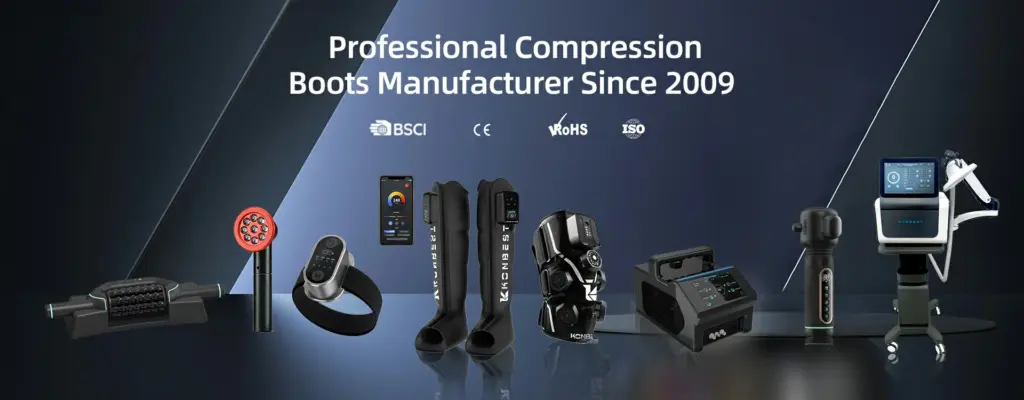
Its listed certifications and compliance-related credentials include CE, ISO, RoHS, and BSCI. Buyers should confirm the exact certification applicable to the selected model and intended market before ordering.
14. A Practical Buying Process
If you are preparing a medium or large B2B order, a simple step-by-step process can reduce purchasing risk.
Step 1: Define Your Customer
Know whether you are selling to athletes, gyms, recovery studios, rehabilitation businesses, retailers, or other professional buyers.
Step 2: Select the Product Level
Compare four-, six-, and eight-chamber products according to your market rather than simply choosing the most advanced model.
Step 3: Compare Specifications
Review pressure control, compression modes, timer, pump, controller, battery, materials, and accessories.
Step 4: Request a Sample
Test the actual product and check both performance and physical construction.
Step 5: Confirm Customization
Finalize the logo, color, packaging, accessories, manual, and other private label requirements.
Step 6: Review the Factory
For larger purchasing programs, consider a factory inspection and ask about production capacity and quality-control procedures.
Step 7: Approve the Final Version
Keep the approved sample and final specification as the production reference.
Step 8: Confirm the Bulk Order
Finalize quantity, MOQ, production schedule, inspection requirements, warranty, shipping, and after-sales support.
Step 9: Plan Future Orders
Keep the same product specification for repeat orders and discuss future models if you plan to expand your recovery product range.
Conclusion
Selecting the right compression boots supplier is a business decision, not only a product decision.
The best supplier for your market should match your target customers, product level, order volume, branding needs, and long-term purchasing plans.
For distributors, wholesalers, and resellers, important factors include compression chamber options, pressure control, construction quality, OEM capability, private label support, accessories, sample service, factory capacity, quality inspection, and after-sales support.
ERCON brings 17 years of sports recovery equipment experience, a 12,000-square-meter manufacturing facility, 5 production lines, international market experience, OEM and ODM capabilities, and support for customized B2B projects.
Before placing a large order, start with the market, test the product, check the factory, approve the specifications, and then move into mass production. This simple process can help you choose a supplier that is suitable not only for your first shipment, but also for your future product plans.
15. Q&A
Q1: What is the most important factor when choosing a compression boots supplier?
There is no single factor. Product quality, compression performance, manufacturing capacity, OEM support, MOQ, lead time, customization, inspection, and after-sales service should all be considered.
Q2: How many chambers should I choose?
It depends on your market. Four-chamber products can suit portable and entry-level applications, while six- and eight-chamber options can be considered for more professional markets.
Q3: Can I buy compression boots in wholesale quantities?
Yes. B2B distributors and wholesalers can purchase compression boots in bulk. The exact MOQ and production schedule should be confirmed according to the selected model and customization requirements.
Q4: Can I use my own brand logo?
Yes. ERCON supports private label and OEM projects, including logo customization, product colors, packaging, and suitable accessory options.
Q5: Should I request a sample before a large order?
Yes. A sample allows you to check compression performance, materials, construction, controls, accessories, packaging, and overall product quality before moving to mass production.
Q6: What should I check when testing a sample?
Check pressure adjustment, inflation sequence, controller operation, pump performance, air tubes, connectors, stitching, material, comfort, battery performance where applicable, and accessories.
Q7: Can the supplier support different products for different customer groups?
Yes. A supplier offering several chamber configurations can help distributors create different product levels for gyms, sports teams, recovery centers, rehabilitation businesses, and resellers.
Q8: Can the factory support large B2B orders?
ERCON has a 12,000-square-meter production facility and 5 production lines. Buyers should discuss the required quantity and production schedule with the factory before confirming a large order.
Q9: Can packaging and accessories be customized?
Yes. Suitable OEM projects can include customized packaging and accessory selection. These details should be approved before mass production.
Q10: Does ERCON support factory inspection?
Yes. Factory inspection support is available for B2B buyers who want to review the manufacturing facility and quality-control process before placing a larger order.