


How to Build a Reliable Supply Chain for Compression Recovery Products
Buying compression recovery products is one thing. Building a supply chain that can support your business for years is another.
For distributors, wholesalers, resellers, and recovery brands, the first order is usually not the hardest part. The real test comes later. What happens when you need more units? What if you want three different models instead of one? Can the factory keep the same quality? Can it handle your private label packaging? Can it ship on time when the order becomes much larger?
These questions are why supplier selection should be treated as a supply chain decision, not just a product purchase.
ERCON has more than 17 years of experience in sports recovery product R&D and manufacturing. Its products are supplied to more than 100 countries, and the company has worked with more than 300 brands on customized projects. With a 12,000-square-meter factory, five production lines, professional R&D and quality control teams, and a wide recovery product range, ERCON provides a practical sourcing option for B2B buyers planning medium and large-volume orders.
- What a Reliable Supply Chain Really Means
- Build the Product Map Before You Buy
- Choose Models by Application, Not Appearance
- Plan for Different Customer Scenarios
- Make the Sample Stage Part of Supplier Testing
- Prepare for the Move From Samples to Bulk Production
- Put Private Label Requirements Into the Supply Plan
- Set Quality Checks Before Production Starts
- Make Delivery Part of the Purchasing Strategy
- Build a Supplier Relationship That Can Scale
- Why ERCON Is Built for Long-Term B2B Supply
- Q&A
What a Reliable Supply Chain Really Means
A reliable supply chain is not simply a factory that can make a product.
For compression recovery equipment, the supply chain starts before production. It includes product planning, technical confirmation, sampling, customization, raw material preparation, manufacturing, inspection, packaging, shipping, and repeat orders.
Every part needs to connect.
For example, imagine a distributor starts with 50 sample units. After testing the market, the distributor needs 300 units across three models. The packaging also needs a new logo and color. At this point, the supplier must do much more than repeat the first order. It needs to manage different product configurations, production planning, customization, inspection, and delivery at the same time.
This is why a reliable supply chain should be designed around future orders, not only today's purchase.
Build the Product Map Before You Buy
One of the first steps is to understand what products you may need over the next 6 to 12 months.
Do not automatically choose one compression boot model for every customer. Different markets can require different product configurations.
ERCON's air compression boots range includes 4-chamber, 6-chamber, and 8-chamber options. The current category includes models such as the 9490 series, 9690 series, and 9890 series, giving B2B buyers several product directions to consider.
For a distributor, this can create a simple product structure:
- 4-chamber models for customers looking for a straightforward recovery product.
- 6-chamber models for buyers who want a more advanced compression configuration.
- 8-chamber models for professional or higher-spec product lines.
This approach is useful because you can plan your inventory around customer groups instead of ordering products without a clear sales purpose.
Choose Models by Application, Not Appearance
Photos are useful for product presentation, but they should not be the main basis for B2B purchasing.
When comparing an air compression boots supplier, look at the specifications that affect real use.
Important details can include the number of chambers, pressure range, massage programs, battery capacity, inflation speed, noise level, screen type, timer settings, pump performance, wireless operation, and overall construction.
For example, the 9490Max is listed as a 4-chamber system with a maximum pressure of 240 mmHg, a 12 L/min pump, noise below 45 dB, dual 3200mAh batteries, and a 3-inch LCD. The 9690K-E is listed with a 5200mAh battery, overlapping chamber design, six massage modes, a large color LCD, and a pressure range of 30–260 mmHg.
These details help a buyer decide where each product belongs in the product portfolio.
A portable model may be easier to position for mobile recovery services. A higher-chamber model may fit a professional recovery center. A wholesaler may prefer to keep several configurations so its customers can choose based on their own needs.
The right model is therefore not simply the one with the longest specification list. It is the one that matches the intended application.
Plan for Different Customer Scenarios
Sports Teams
Sports teams often need equipment that can fit into regular training and competition routines. Staff may use the equipment frequently, so simple controls, reliable operation, suitable pressure settings, and easy handling can be important.
Distributors serving sports organizations should therefore look beyond the product itself and also check battery performance, accessories, operating instructions, and replacement support.
Gyms and Fitness Centers
For gyms, the equipment may be placed in a dedicated recovery area. Different users may operate the products during the same day.
In this situation, a clear interface and easy operating process can be valuable. A distributor can also offer different chamber configurations to fit different facility requirements.
Recovery Centers
Recovery centers often use several types of equipment rather than relying on one product.
Compression boots can be part of a wider recovery setup that may also include cold therapy equipment, ice bath systems, massage devices, or other recovery products.
This is where a supplier with a broader product range can simplify sourcing. ERCON provides a wider sports recovery equipment portfolio, allowing B2B buyers to consider more than one product category when planning their supply chain.
Physiotherapy and Rehabilitation Businesses
Professional facilities may require more technical information before making a purchase. They can ask about product specifications, operation, accessories, documentation, quality processes, and after-sales support.
A supplier that can answer these questions clearly can make the purchasing process much easier for distributors and resellers.
Make the Sample Stage Part of Supplier Testing
A sample should answer two questions:
- Does the product meet your requirements?
- Can the supplier work with your company?
The first question is about the equipment. The second is about the relationship.
During the sample stage, check the product operation, pressure control, chamber sequence, battery performance, noise level, accessories, packaging, and user instructions.
At the same time, check the supplier's communication. Are technical questions answered clearly? Are changes recorded correctly? Does the supplier understand your target market? Can it explain production timing?
ERCON provides 2-day sampling support according to the provided company information. The actual sample schedule should be confirmed according to the selected model and customization requirements.
If the supplier performs well during sampling, you have a stronger basis for moving toward larger purchasing volumes.
Prepare for the Move From Samples to Bulk Production
The move from samples to bulk orders is where many supply chains become difficult.
A sample order may contain one model. A larger order may contain several models, different colors, custom packaging, accessories, and specific electrical requirements.
Before placing a large purchase order, confirm:
- Exact model numbers
- Product specifications
- Quantity for each model
- Accessories
- Packaging requirements
- Logo and color details
- Electrical configuration
- Inspection requirements
- Production schedule
- Shipping arrangement
It is also useful to keep the approved sample and final specification as a reference for future production.
This becomes especially important for compression boots wholesale orders. When the quantity increases, small differences between models or batches can become much more noticeable. A clear specification helps both the buyer and factory work from the same information.
Put Private Label Requirements Into the Supply Plan
Private label projects need to be planned early.
ERCON supports private label logo, color, packaging, and accessory customization. For distributors and resellers, these services can be included in the same purchasing plan as the product order.
But customization should not be left until the production date is close.
Before production, confirm the logo position, printing method, product color, carton design, labels, manual language, accessories, shipping marks, and other brand requirements.
For a private label compression boots project, packaging can be just as important as the equipment because the product, carton, labels, and accessories all need to match the approved brand specification.
A well-organized supplier should also be able to tell you which customization requests may affect the production schedule.
Set Quality Checks Before Production Starts
Quality control works better when the standard is agreed before production.
Instead of waiting until the goods arrive at your warehouse, decide in advance what needs to be checked.
For compression recovery products, buyers can create inspection points around:
- Product appearance
- Chamber operation
- Pressure control
- Battery function
- Screen and control system
- Accessories
- Logo and color
- Packaging
- Product quantity
ERCON has dedicated R&D and quality control teams and provides factory inspection support. The company also operates a 12,000-square-meter production facility with five production lines.
For medium and large B2B orders, factory inspection can provide another level of confidence because buyers can review the production environment and quality management process before expanding cooperation.
Make Delivery Part of the Purchasing Strategy
Delivery should be discussed before the purchase order is finalized.
For larger orders, ask the factory to confirm the timeline for sample approval, customization, production, inspection, packaging, and shipment.
ERCON provides 7-day shipping support according to the provided company information. However, the final delivery schedule should always be confirmed based on order quantity, selected model, customization, packaging, destination, and other order conditions.
For distributors and wholesalers, delivery planning also affects warehouse management. If several models are arriving together, you need to know the expected timing before arranging inventory space and downstream distribution.
A clear schedule makes communication between the factory, importer, warehouse, and local sales team much easier.
Build a Supplier Relationship That Can Scale
A good supplier should not only handle today's order. It should also be able to support the next stage of your purchasing plan.
For a new reseller, the process may start with samples. For an established distributor, it may begin with hundreds of units. Later, the business may need repeated orders, new colors, new packaging, several models, or additional recovery equipment.
This is why factory capability matters.
ERCON has more than 17 years of sports recovery R&D and manufacturing experience, products supplied to more than 100 countries, and customization experience with more than 300 brands. Its 12,000-square-meter factory and five production lines provide a manufacturing base for larger B2B purchasing programs.
The company also has a wider recovery equipment portfolio. This can help buyers create a more connected purchasing plan instead of managing too many unrelated suppliers.
Why ERCON Is Built for Long-Term B2B Supply
For distributors, wholesalers, and resellers searching for a reliable compression boots manufacturer, ERCON combines manufacturing experience with product variety and customization support.
- More than 17 years of sports recovery product R&D and manufacturing experience.
- Products supplied to more than 100 countries.
- Customization experience with more than 300 brands.
- 12,000-square-meter factory.
- Five production lines.
- 4-chamber, 6-chamber, and 8-chamber compression boot options.
- Private label logo and color customization.
- Custom packaging and accessories.
- OEM and ODM support.
- 2-day sampling support.
- 7-day shipping support, subject to order conditions.
- Factory inspection support.
- CE, RoHS, BSCI and other certification support according to product and market requirements.
- Broader sports recovery equipment for one-stop sourcing.
The current air compression boots category provides multiple product choices for B2B buyers, including different chamber configurations and product designs. This allows distributors to build a more flexible product portfolio instead of depending on a single model.
The key to a reliable supply chain is not complicated. Start with the right product plan. Confirm the technical details. Test the samples. Set the quality standard. Finalize private label requirements. Check production capability. Then create a delivery and repeat-order plan.
This process gives distributors and wholesalers a clearer path from their first purchase to larger orders.
For businesses planning medium or large-volume purchasing, the factory should become part of the supply strategy. A supplier with manufacturing experience, multiple product options, customization support, quality control, and scalable production can make long-term sourcing much easier to manage.
ERCON provides compression recovery products and related sports recovery equipment for distributors, wholesalers, resellers, sports organizations, gyms, recovery centers, and other B2B buyers looking to build a stable product supply.
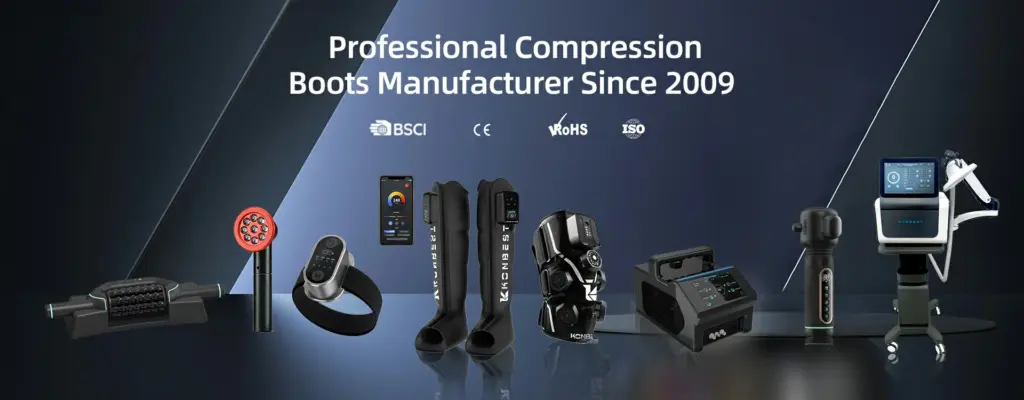
Q&A
1. What makes a compression recovery product supply chain reliable?
A reliable supply chain needs stable product quality, clear specifications, consistent production, reasonable lead times, quality inspection, customization support, packaging control, and good communication between the buyer and factory.
2. What should distributors check before placing a large compression boot order?
Distributors should confirm model numbers, chamber configuration, pressure range, battery specifications, accessories, packaging, branding, electrical requirements, production timing, inspection standards, and shipping arrangements.
3. Does ERCON offer different compression boot configurations?
Yes. ERCON's current air compression boots range includes 4-chamber, 6-chamber, and 8-chamber options, with multiple models available for different B2B applications.
4. Can ERCON support private label compression boots?
Yes. ERCON supports private label logo, color, packaging, and accessory customization, as well as OEM and ODM cooperation. Specific options and MOQ should be confirmed for each model.
5. Can I test samples before moving to a bulk order?
Yes. ERCON provides 2-day sampling support according to the provided company information. The final sample schedule depends on the selected model and customization requirements.
6. Can a B2B buyer inspect the factory?
Yes. ERCON supports factory inspection, allowing distributors and other B2B buyers to review the production environment and manufacturing capability before larger cooperation.
7. Can I source other recovery equipment from ERCON?
Yes. ERCON provides a wider range of sports recovery equipment, including air compression boots and other recovery product categories, which can support a broader one-stop sourcing strategy.
Planning a medium or large-volume order of compression recovery products? ERCON can support product selection, sampling, OEM/ODM customization, private labeling, packaging, accessories, factory inspection, and long-term B2B supply planning.