


How Do I Choose Cold Therapy Equipment for Rehabilitation Centers?
Choosing cold therapy equipment for rehabilitation centers starts with one question: What does the facility need to do every day? A physiotherapy clinic may need targeted cooling for the knee or shoulder. A sports recovery center may want cold and hot contrast therapy with adjustable compression. A performance facility may need an ice bath for full-body immersion.
For distributors, wholesalers, and resellers, the decision also affects product selection, staff training, spare parts, and repeat orders. Buying equipment that does not match the customer's workflow can create problems long after delivery.
ERCON specializes in cold and hot therapy equipment, with 17 years of sports recovery product R&D and manufacturing experience. Its range includes water-circulation therapy systems, wearable cold and hot devices, contrast compression machines, and ice bath tubs. This guide explains how to compare these options, choose suitable models, and prepare for a medium or large B2B order.
- Quick Answer: Which Equipment Should I Choose?
- 1. Start With the Rehabilitation Center's Needs
- 2. Understand the Main Equipment Types
- 3. Compare Six ERCON Models
- 4. Check These Technical Details Before Buying
- 5. Match Products to Real Business Scenarios
- 6. Plan a Medium or Large B2B Order
- 7. How to Evaluate a Cold Therapy Equipment Manufacturer
- Questions and Answers
Quick Answer: Which Equipment Should I Choose?
The best option depends on the service offered, the available space, and how staff will use the equipment. Use this quick guide to narrow the choices before requesting a quotation.
| Rehabilitation Center Need | Equipment Type to Consider | ERCON Model |
|---|---|---|
| Targeted cold therapy for selected body areas | Water-circulation cold therapy system | CL05A / CL05B — confirm the exact variant |
| Cold and hot therapy with adjustable compression | Contrast compression therapy machine | EK-810 or CL08 |
| A wearable format for targeted applications | Wearable cold and hot therapy device | CL803 |
| Full-body cold immersion | Ice bath tub with chiller | CB02 |
This is a starting point, not a substitute for clinical assessment. The facility should choose the final equipment and settings according to its treatment protocols, trained staff, and intended users.
1. Start With the Rehabilitation Center's Needs
Before comparing prices, define the work the equipment must support. A clinic that treats different body areas may need targeted therapy pads and several wrap sizes. A sports performance center may want a separate immersion area. A rehabilitation group with several branches may need the same model and accessories at every location.
Check the Treatment Area
First, identify whether the main requirement is local cooling, cold and hot contrast therapy, compression-assisted treatment, or full-body immersion. These are different applications, and one device may not cover all of them.
Estimate Daily Use
Think about the number of sessions, the time needed to prepare the equipment, and how staff will clean and store it between users. For a busy center, simple controls, clear operating instructions, and a practical accessory system can be as important as the headline specifications.
Review Space and Utilities
A circulating water system needs space for the machine, hoses, pads, and storage. An ice bath needs more room, along with suitable water handling, drainage, cleaning, and user access. Check power supply and local electrical requirements before choosing the final configuration.
Consider the Local Market
For distributors and importers, local compliance matters from the start. Confirm the documents, product labeling, electrical configuration, language requirements, and permitted product claims for the destination country. This step helps avoid problems after the order has shipped.
2. Understand the Main Equipment Types
Water-Circulation Cold Therapy Systems
These systems circulate chilled water through a connected pad placed around a selected body area. They can be considered by clinics that want targeted cooling without setting up a full-body immersion space.
For example, the ERCON CL05 product page lists a 9-liter capacity, a nylon-and-TPU cold pad, and noise below 40 dB. Its listed working time is up to 12 hours under the stated conditions. The pad design supports use on areas such as the knee, shoulder, back, hip, and ankle, depending on the supplied configuration.
For CL05A and CL05B orders, ask ERCON to confirm the exact differences between the variants, including reservoir design, included pads, controls, and accessories.
Cold and Hot Contrast Compression Machines
A contrast compression machine combines temperature control with pneumatic compression. Instead of purchasing separate machines for each function, a center can consider an integrated system where the selected model supports the required applications.
The ERCON EK-810 combines cold therapy, heat therapy, and compression. Its listed cold range is 3–15°C, its heat range is 40–55°C, and its pressure range is 30–180 mmHg. The machine also lists a 2-liter water tank and water flow of 370 ± 50 L/h.
The CL08 offers another cold and hot compression option, with selectable temperature and pressure settings. Buyers should compare the two models based on their required operating range, pad compatibility, session workflow, and total equipment cost.
Wearable Cold and Hot Therapy Devices
Wearable equipment may suit centers that want a compact format for targeted applications. ERCON's CL803 is a wearable cold and hot therapy device designed for sports recovery and rehabilitation settings.
Before ordering, confirm the supported wrap sizes, body areas, temperature modes, charging method, controller, and included accessories. These details help distributors match the product to customer requirements rather than relying on the product name alone.
Ice Bath Tubs With Chillers
An ice bath is designed for cold-water immersion rather than localized treatment. It may be considered by sports teams, performance centers, gyms, and rehabilitation facilities with a dedicated recovery area.
The ERCON CB02 is an inflatable ice bath tub with a chiller. Its listed features include a 3–42°C temperature range, Wi-Fi and app control, an 8-inch LCD panel, a water filter and ozonator, and an insulated wall structure. The listed tub size is 135 × 80 × 65 cm.
For commercial use, check water maintenance, cleaning procedures, access around the tub, drainage, and the facility's user-supervision plan before installation.
3. Compare Six ERCON Models
A useful B2B product range covers different customer needs without forcing every customer to buy the same machine. The table below shows how the six requested models can fit into a product portfolio. Confirm the latest model-specific specifications and accessories before placing an order.
| Model | Main Function | Specifications or Features to Review | Potential B2B Application |
|---|---|---|---|
| EK-810 | Cold, heat, and pneumatic compression | Cold 3–15°C; heat 40–55°C; pressure 30–180 mmHg; 2L tank; 370 ± 50 L/h listed water flow | Rehabilitation clinics, sports recovery centers, and professional training facilities |
| CL08 | Cold and hot contrast compression | Cold settings of 3°C, 8°C, and 12°C; heat settings of 40°C, 42°C, and 43°C; pressure settings of 45, 70, and 100 mmHg | Clinics and distributors seeking a compact contrast therapy option |
| CL05A | Water-circulation cold therapy | Confirm the exact reservoir, pad, controller, and accessory package for this variant | Targeted cold therapy product lines |
| CL05B | Water-circulation cold therapy | Compare the approved configuration, included pads, water handling, and operating requirements with CL05A | Rehabilitation equipment distributors and sports recovery suppliers |
| CL803 | Wearable cold and hot therapy | Confirm wrap options, supported body areas, temperature settings, charging, and included accessories | Facilities that need wearable targeted therapy equipment |
| CB02 | Inflatable ice bath with chiller | Listed 3–42°C range; app and Wi-Fi control; 8-inch LCD panel; filter and ozonator; 135 × 80 × 65 cm size | Sports performance facilities, gyms, and immersion recovery areas |
For a distributor, the advantage of this product mix is simple: it covers targeted cold therapy, contrast compression, wearable equipment, and cold immersion. The sales team can recommend a suitable product family first and then compare models within that family.
View the complete ERCON cold therapy equipment range to review the available product categories.
4. Check These Technical Details Before Buying
When a rehabilitation center or distributor compares equipment, a few technical details can make a real difference to daily use. Ask the manufacturer to provide a current specification sheet for the exact model being quoted.
Temperature Range and Stability
Check the cold and heat settings, the control method, and the time needed to reach the selected temperature. For EK-810, the listed ranges are 3–15°C for cold therapy and 40–55°C for heat therapy. CL08 offers three listed cold settings and three listed heat settings.
When testing a sample, check temperature behavior over a complete operating cycle, not only the value shown when the machine first starts. Actual performance may depend on ambient conditions, water volume, and operating settings.
Pressure Range and Pad Fit
If compression is part of the system, review the available pressure settings and how they are controlled. EK-810 lists 30–180 mmHg, while CL08 lists 45, 70, and 100 mmHg settings. Also check whether the included wrap fits the intended body area and whether replacement pads or additional sizes are available.
Do not assume that a pad or wrap from one model will fit another. Ask for written confirmation of compatibility before ordering extra accessories.
Water Capacity and Circulation
Reservoir capacity and water flow are useful comparison points for circulating systems. EK-810 lists a 2-liter tank and 370 ± 50 L/h water flow. The CL05 product page lists a 9-liter capacity. These systems have different designs, so compare them according to the intended use and the manufacturer's operating instructions.
Noise, Power, and Installation
Noise may matter in a quiet treatment room. Power supply and installation requirements matter when equipment will be shipped to another country. The CL05 product page lists noise below 40 dB, while EK-810 lists AC100–240V, 50/60Hz input. Confirm the current electrical configuration, plug type, and local compliance documents for the ordered model.
Cleaning and Routine Maintenance
Ask how to clean the pads, wraps, hoses, water tank, and contact surfaces. For ice bath systems, confirm the water treatment process, filter replacement requirements, drainage, and routine maintenance schedule. A clear maintenance plan helps the facility prepare for regular use and helps the distributor answer customer questions.
5. Match Products to Real Business Scenarios
Scenario A: A Physiotherapy Clinic With Limited Space
A small clinic may need targeted cooling without reserving a large area for immersion. A circulating cold therapy system such as a suitable CL05 variant may be worth evaluating. Before choosing, check the pad sizes, the space needed for the machine, and how the equipment will be cleaned between users.
Selection logic: Start with the body areas the clinic serves, choose the matching pad configuration, and test the setup with staff before deciding on the order quantity.
Scenario B: A Rehabilitation Center Offering Several Therapy Options
A center that wants cold, heat, and compression in one unit can compare EK-810 and CL08. The listed temperature and pressure settings give buyers a starting point for reviewing the available functions. The final choice should depend on the center's protocols, accessories, workflow, and budget.
Selection logic: Compare the two models using a checklist of temperature range, pressure settings, tank capacity, wrap compatibility, controls, cleaning, and service support. Test the preferred configuration before standardizing it across treatment rooms.
Scenario C: A Sports Performance Facility
A sports facility may use targeted therapy devices in treatment rooms and consider CB02 for a separate cold immersion area. These are different product categories, so they should be planned around the facility layout, water handling, user supervision, and intended routines.
Selection logic: Map each product to a specific area of the facility. Confirm the installation requirements for the ice bath and the accessory options for targeted therapy devices before finalizing the equipment list.
Scenario D: A Distributor Supplying Several Types of Customers
A distributor serving clinics, gyms, sports teams, and wellness facilities may benefit from a small but clearly organized product range. One option is to start with targeted cold therapy, add a contrast compression model, and offer an ice bath for customers with a dedicated immersion area.
Selection logic: Group products by application, prepare a specification sheet for each model, and train sales staff to explain the difference between water circulation, contrast compression, wearable therapy, and immersion. This makes product matching clearer for buyers.
6. Plan a Medium or Large B2B Order
For medium and large orders, product selection is only the first step. The next task is to make sure the approved sample, production specification, packaging, and delivery plan all match the purchase order.
Step 1: Define the Target Market
List the types of customers you plan to serve, the countries where the products will be sold, and the product categories you want to stock. This helps the manufacturer recommend a suitable model mix rather than quote equipment that does not match your market.
Step 2: Request a Detailed Quotation
Ask for the unit price, MOQ, lead time, accessories, packaging, warranty, spare-parts availability, and shipping terms. If the order includes several models, request a separate line for each model and customization option.
Step 3: Test and Approve Samples
Check controls, temperature behavior, pressure settings where applicable, water circulation, wraps, connectors, accessories, and packaging. ERCON supports 2-day sampling for applicable projects; confirm sample availability and timing for the specific models.
Step 4: Approve Customization in Writing
For private-label orders, confirm the logo artwork, color, packaging, labels, user manual, and included accessories. Approve the final sample and specification before mass production begins.
Step 5: Review Quality Control and Factory Capability
Ask how incoming materials, assembly, and finished products are checked. For a larger order, arrange a factory inspection if needed. Confirm which inspection records or product documents can be supplied with the order.
Step 6: Confirm Delivery and After-Sales Support
Agree on the production schedule, shipping method, delivery destination, warranty, technical support, and spare-parts process. ERCON lists 7-day shipping for applicable projects, but the actual schedule depends on the model, order size, customization, stock, and shipping arrangements. Get the confirmed delivery date in writing.
7. How to Evaluate a Cold Therapy Equipment Manufacturer
A reliable cold therapy equipment manufacturer should be able to support product selection, sample evaluation, production quality, documentation, and repeat orders. A low unit price alone does not show whether a supplier can meet your requirements over time.
When comparing manufacturers, review these points:
- Manufacturing experience: Ask how long the company has worked in sports recovery and what product categories it makes.
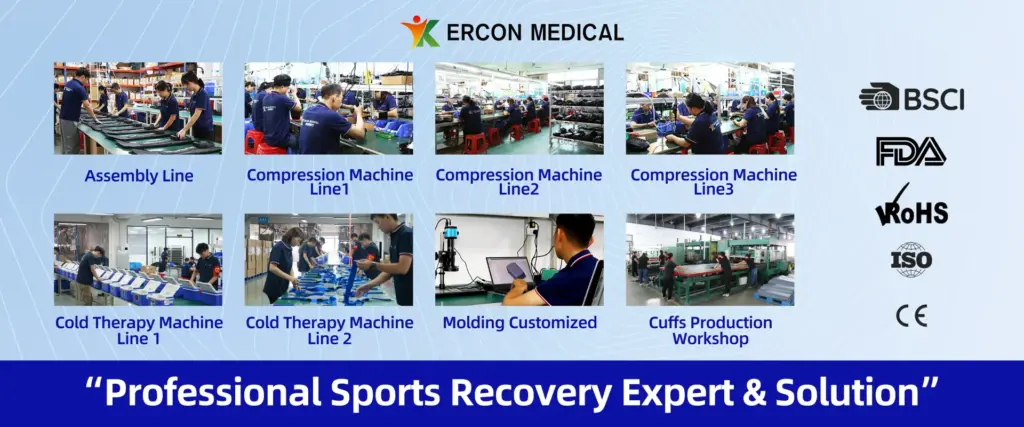
- Production capacity: Review the factory layout, production lines, assembly process, and capacity for the order quantity you need.
- R&D and customization: Check whether the supplier can support suitable OEM/ODM projects and confirm the limits of each customization option.
- Quality inspection: Ask how product performance, assembly, accessories, and finished units are checked.
- Documentation: Request the certificates and compliance documents relevant to the exact model and destination market.
- After-sales support: Confirm warranty terms, replacement parts, technical help, and the process for handling product issues.
- Factory inspection: If required, arrange a visit or inspection before committing to a larger purchase.
ERCON has 17 years of sports recovery product R&D and manufacturing experience, exports to more than 100 countries, and has completed over 300 brand customization projects. Its 12,000-square-meter factory includes five production lines, a product showroom, and R&D and quality inspection teams.
ERCON refers to CE, ISO, RoHS, and BSCI-related credentials. Before placing an order, request the current documents and confirm their scope for the specific model and destination market. Do not assume that one certificate applies to every product.
Ready to compare models for your market? Visit the ERCON cold therapy equipment range and request a quotation based on your target products, quantity, customization requirements, and delivery destination.
Questions and Answers
1. What cold therapy equipment is best for rehabilitation centers?
It depends on the application. Water-circulation systems are designed for targeted cooling, contrast compression machines combine temperature therapy and compression, wearable devices offer a compact format, and ice baths support full-body immersion. Choose according to the facility's protocols, space, and trained staff.
2. What is the difference between EK-810 and CL08?
Both combine cold, heat, and compression. EK-810 lists a 3–15°C cold range, a 40–55°C heat range, and a 30–180 mmHg pressure range. CL08 lists three cold settings, three heat settings, and pressure settings of 45, 70, and 100 mmHg. Confirm the current specification sheets before ordering.
3. What should I check before buying an ice bath?
Review the chiller temperature range, tub size, insulation, control method, filtration, water treatment, power requirements, drainage, cleaning, and maintenance. Also check the space available for safe access around the tub.
4. Can ERCON support private-label cold therapy equipment?
Yes. ERCON supports suitable OEM/ODM projects, including logo, color, packaging, and accessory customization. Confirm MOQ, artwork approval, sample timing, production lead time, and the final specification before placing a bulk order.
5. Can distributors order multiple models in one purchase?
Multi-model orders can be discussed according to the required quantities, customization, and delivery plan. Ask for separate quotations and lead times for each model so you can plan stock and delivery more accurately.
6. Does ERCON support factory inspection?
Yes. ERCON supports factory inspection for B2B buyers. Arrange the inspection in advance and agree on the areas to review, including production lines, quality checks, assembly, and finished-product inspection.
7. What is the best way to compare cold therapy equipment wholesale suppliers?
Compare the exact specifications, sample performance, accessory compatibility, quality inspection, certificates, MOQ, lead time, warranty, spare parts, and customization support. Use the same checklist for each supplier instead of comparing only the quoted unit prices.
Choosing cold therapy equipment for rehabilitation centers is easier when the decision follows a clear process: define the application, compare the technology, check the specifications, test the sample, and confirm the manufacturer's ability to support the order. For distributors, wholesalers, and resellers planning medium or large purchases, ERCON offers several cold and hot therapy product types and customization options to help build a product range for different professional settings.