


How European Distributors Can Choose the Right Cold Therapy Partner
Buying recovery products for Europe is not simply a matter of finding a factory with a low quotation.
A distributor may receive ten similar offers from different suppliers. On paper, many of them can look almost the same. The difficult part starts later. Can the supplier keep the same specification for the next order? Can it provide the right product documents? Can it make your packaging correctly? Can it handle a larger production plan when your sales network grows?
These are the questions that matter when choosing a long-term cold therapy equipment supplier.
For European distributors, wholesalers, and resellers, the selection process should therefore look at the whole supply chain, from product design and sample testing to production, inspection, customization, and shipment.
ERCON has more than 17 years of sports recovery product R&D and manufacturing experience. Its products are supplied to more than 100 countries, and the company has completed more than 300 brand customization projects. With a 12,000㎡ factory, 5 production lines, R&D and QC teams, and a wide recovery equipment range, ERCON can support buyers who are moving from simple resale toward a more stable product program.
- 1. Look at Your Market Before Looking at the Factory
- 2. Check Whether the Supplier Has a Real Product Family
- 3. Read the Technical Data Carefully
- 4. Think About How the Equipment Will Be Used
- 5. Treat the Sample as a Purchasing Test
- 6. Product Documents Matter in European Sales
- 7. Ask What Happens After the First Shipment
- 8. When Should a Distributor Add Its Own Brand?
- 9. Why a Factory Visit Can Be Worthwhile
- 10. A Practical Supply Option for Growing Distributors
- 11. Q&A
1. Look at Your Market Before Looking at the Factory
The first thing a European buyer should decide is not which machine to buy. It is which customers the product needs to serve.
A distributor selling to professional sports clubs may need a different range from a company supplying physiotherapy clinics. A gym equipment wholesaler may prefer compact products that are easy for staff to operate. A reseller may need a product that can sit naturally beside massage guns, recovery boots, and other sports recovery products.
This changes the purchasing decision.
For example, a professional recovery center may need a dedicated water cooling system for regular sessions. Another facility may want cooling together with pneumatic compression. A larger gym may be interested in an ice bath solution instead.
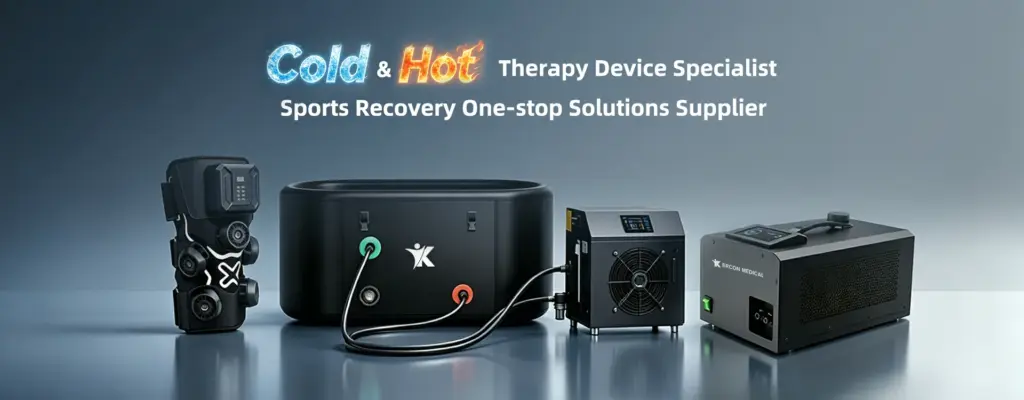
ERCON's product category includes several formats, including cold water circulation systems, cold water compression products, contrast therapy equipment, semiconductor cooling and heating devices, and ice bath solutions. This gives a distributor more room to build a range around different customer needs rather than forcing every buyer into one machine.
2. Check Whether the Supplier Has a Real Product Family
A supplier with only one product can still be useful. But for a distributor planning larger purchasing volumes, a broader product family can make future sourcing much easier.
Imagine that you currently sell one cooling device. Six months later, your customers ask for cold compression. Later, another customer wants an ice bath. If every product comes from a different factory, you have to manage several suppliers, specifications, packaging systems, spare parts arrangements, and quality standards.
A manufacturer with several related product lines can reduce this complexity.
| Product Type | Possible Customer | Typical Purchasing Concern |
|---|---|---|
| Cold water circulation | Recovery centers and sports facilities | Cooling performance and water circulation |
| Cold water compression | Physio and rehabilitation businesses | Cooling plus pressure control |
| Contrast therapy | Professional recovery facilities | Temperature range and multi-function operation |
| Ice bath | Gyms, clubs and wellness centers | Size, insulation, water care and temperature control |
| Portable therapy products | Retailers and recovery resellers | Size, operation and packaging |
This type of product structure is particularly useful for a cold therapy equipment wholesale business because the distributor can serve several market segments without changing its main manufacturing relationship every time.
3. Read the Technical Data Carefully
Good product photography is useful for sales. It is not enough for purchasing.
Before approving a model, ask for its complete technical specification. Some of the most important points include:
- Cooling temperature
- Heating temperature where applicable
- Water tank capacity
- Water circulation speed
- Pressure range
- Timer settings
- Rated power
- Voltage and frequency
- Dimensions and weight
- Control method
- Accessories
- Warranty
For example, the EK-810 combines cooling, heating, and pneumatic compression. Its listed parameters include a 3–15°C cooling range, 40–55°C heating range, 2L water tank, 370 ± 50L/h water flow, 30–180 mmHg pressure range, and 5–90 minute timer. It is also listed with AC100–240V input.
These numbers tell a buyer much more than the phrase “professional recovery machine.” They also make it easier for a purchasing team to compare different models without relying only on the sales quotation.
4. Think About How the Equipment Will Be Used
The same recovery product can have very different requirements depending on its working environment.
A football training center may operate equipment many times during a week. A physiotherapy business may need simple controls and easy cleaning. A recovery studio may want several functions in one device because space is limited.
This is why product selection should follow the workflow.
For example, the CL03A is a portable cold water compression system. Its listed parameters include an 8L water capacity, 0–150 mmHg pressure range, 370 ± 50L/H flow rate, and 5–120 minute timer.
A system with this type of specification can be considered for businesses that want cooling and pneumatic compression in one recovery setup.
At the larger end of the range, the CB02 inflatable ice bath uses an insulated 80mm wall and drop-stitch PVC construction. It is listed with a 3–42°C temperature range, water filtration, ozonator purification, WiFi/app control, and an 8-inch LCD screen. Its listed size is 135 × 80 × 65cm.
For a distributor, these two products should not be treated as direct substitutes. They solve different purchasing requirements.
5. Treat the Sample as a Purchasing Test
One of the easiest ways to reduce risk is to test the actual product before committing to a large order.
But the sample should be checked in a more complete way than simply switching it on.
A buyer can review the control panel, product materials, water connections, accessories, labels, packaging, manual, plug type, noise, and general operation. If the project includes private labeling, check the logo, colors, package artwork, and other customized details at the same time.
ERCON supports 2-day sampling for applicable projects. This can help a distributor move from an online quotation to an actual product check before production begins.
A simple internal approval sheet can include:
- Approved model number
- Technical specification
- Product appearance
- Color
- Logo position
- Accessories
- Package version
- User manual
- Inspection requirements
Once these points are approved, the sample becomes a useful reference for the larger order.
6. Product Documents Matter in European Sales
European distributors also need to think about compliance and documentation before the shipment leaves the factory.
Do not accept a general statement such as “the factory has certificates.” Ask for the documents connected with the actual model and the intended market.
Depending on the product and destination, the buyer may need technical specifications, manuals, declarations, test information, labels, packaging information, and other documentation.
ERCON lists CE, ISO, RoHS, and BSCI among its certification and compliance credentials. However, the exact documents should always be confirmed for the specific product, configuration, and European destination before purchasing. This is especially important when a distributor is importing equipment under its own brand.
For a cold therapy machine supplier, documentation is therefore part of the product service, not an extra detail that can be discussed after production.
7. Ask What Happens After the First Shipment
This is one question that every serious distributor should ask.
“If I order the same model again next year, how will you make sure I receive the same product?”
The answer should include version control and production records.
The approved model, technical parameters, product color, packaging, accessories, labels, and other important details should be clearly recorded. This helps prevent small changes from appearing in later batches without the buyer knowing about them.
For a wholesaler with several resellers, consistency becomes even more important. The product shown to one customer should match the product delivered to another customer months later.
ERCON has five production lines and supports OEM/ODM cooperation. Its manufacturing setup is designed to support both product development and larger B2B production projects.
8. When Should a Distributor Add Its Own Brand?
Private label is not always necessary for a first order.
If you are still testing the market, standard products can be a reasonable starting point. Once you know which models receive repeat demand, your own branding becomes more practical.
A private-label project can include:
- Logo customization
- Product color selection
- Custom packaging
- Brand manuals and labels
- Accessories
- Other agreed product details
This is where an experienced OEM cold therapy equipment manufacturer can make the transition easier.
ERCON has completed more than 300 brand customization projects and supports private-label logo, color, packaging, and accessory customization for applicable models.
For a distributor, the best approach is often to keep the first private-label range focused. Two or three products with clear differences are easier to manage than a large catalog with many similar models.
9. Why a Factory Visit Can Be Worthwhile
Once the purchasing volume becomes significant, a factory inspection can provide information that a product catalog cannot.
A buyer can look at the production area, equipment, quality inspection process, R&D resources, storage, packaging process, and finished-product inspection.
ERCON operates a 12,000㎡ manufacturing facility with five production lines, advanced R&D and QC teams, and a high-end product showroom. Factory inspection is also supported for applicable B2B projects.
This is useful for distributors that are considering a long-term supply relationship rather than a one-time purchase.
10. A Practical Supply Option for Growing Distributors
The best cold therapy equipment manufacturer for a European distributor is not simply the company with the largest catalog or the lowest quotation.
A better supplier should be able to answer practical questions throughout the buying process:
- Can you recommend models for my customer groups?
- Can I receive a sample before a larger order?
- Can the specification be kept stable between batches?
- Can you support my logo and packaging?
- Can you provide the required product documents?
- Can I inspect the factory?
- Can you support repeat production?
- Can you add related recovery products later?
ERCON is built around this type of B2B cooperation. The company has 17 years of sports recovery R&D and manufacturing experience, supplies products to more than 100 countries, and has worked on more than 300 customized brand projects.
Its product range covers cold water systems, compression cooling, contrast therapy, semiconductor cooling and heating, and ice bath solutions. For distributors and wholesalers, this creates a practical base for building a wider recovery equipment category instead of purchasing unrelated products from many factories.
ERCON also supports 2-day sampling and 7-day shipping for applicable projects, together with OEM/ODM, private-label customization, and factory inspection support.
If your European distribution business is ready to move from occasional product purchases toward a stable recovery equipment range, start by comparing the product specifications, sample quality, documentation, production capability, and customization options.
Check ERCON's cold therapy solutions and contact the factory to discuss samples, model selection, private label requirements, and medium or large-volume orders.
11. Q&A
What should a European distributor check first?
Start with the customer group and actual use scenario. Then compare product specifications, documentation, sample quality, production capability, and long-term supply support.
What products can European wholesalers source from ERCON?
The current range includes cold water circulation systems, cold water compression products, contrast therapy equipment, semiconductor cooling and heating devices, and ice bath solutions.
Can ERCON support private-label projects?
Yes. ERCON supports logo, product color, packaging, and accessory customization for applicable models. The company has experience with more than 300 brand customization projects.
Can I test a product before placing a large order?
Yes. ERCON supports 2-day sampling for applicable projects. Buyers can use the sample to check the actual product and customized details before mass production.
What should I check in the product specification?
Important points include temperature range, water capacity, flow rate, pressure range, timer, power supply, dimensions, weight, control method, accessories, and warranty.
Does ERCON support factory inspection?
Yes. Factory inspection is supported for applicable B2B projects. Buyers can review production capability and quality control before moving to a larger purchasing program.